Waldorf Astoria New York and the Work of Returning
Some hotels are restored as assets; a rarer few are restored as civic interiors. Waldorf Astoria New York belongs firmly to the latter category. Its return after an eight-year closure is not simply the reopening of a celebrated address on Park Avenue, but the reactivation of a building that has long held an unusual position between hotel, theatre, social club and urban landmark.
The 1931 tower by Schultze & Weaver has re-emerged following a far-reaching programme led architecturally by Skidmore, Owings & Merrill, with hotel interiors by Pierre-Yves Rochon. The undertaking had an inherently difficult brief: transform most of a landmarked skyscraper into residences and a smaller hotel while returning its defining public rooms to a coherence that years of alteration had obscured.
For the traveller, the significance lies less in the scale of the intervention than in its sequence. Here, arrival is again permitted to feel ceremonial. A lobby is not merely a check-in zone; a corridor has the tempo of a promenade; the ballroom is not an event container but a room with a past sufficiently vivid to shape its present.
A hotel rebuilt around its public rooms
The restoration retained and renewed the historic core of the property: 62,000 square feet of landmarked lobbies, corridors, ballrooms and related public spaces. Around those rooms, the wider building was substantially reconfigured, with 375 hotel keys and 372 residences now occupying a structure that once operated wholly as a hotel. It is an unusually clear example of adaptive reuse in which the most culturally important spaces have not been converted into private spectacle.
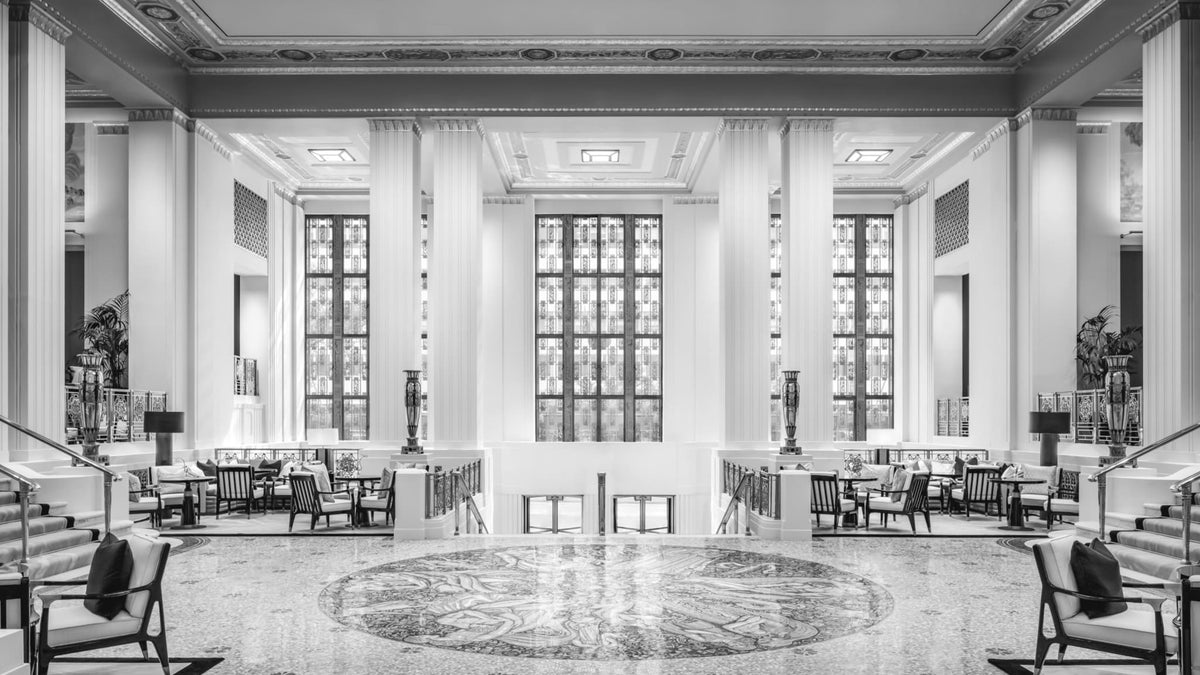
The Park Avenue lobby establishes the argument immediately. Its Wheel of Life mosaic, made from 148,000 hand-cut tiles by French artist Louis Rigal, remains a visual centre of gravity beneath the high ceiling. Rather than treating such ornament as an inherited backdrop, the restoration gives it air, order and legibility. Seating is arranged for lingering, conversation and observation rather than quick circulation. The room works as an interior street: formal enough for a meeting, relaxed enough for the unscripted pause between one part of the day and the next.
That attention to use matters. A grand hotel needs its grandeur to remain inhabited. The best historic properties understand that a public room becomes more persuasive when guests can use it without performing for it. At the Waldorf, marble, decorative plaster, metalwork and patterned surfaces are not presented as museum pieces. They carry the practical work of welcome.
The discipline of restoration
The project demanded more than surface repair. SOM’s team undertook extensive archival and on-site research to distinguish original fabric from later interventions, while specialist conservators addressed murals, metal elements and light fittings. The work is especially evident in the Silver Corridor, whose sequence of murals by Edward Simmons had accumulated decades of grime and unsympathetic repairs. Their cleaning returned greater tonal range to the painted skies and seasonal scenes, allowing the corridor’s silvery architecture to operate with its intended luminosity.
Such work can sound technical, but it changes the emotional temperature of a place. A restored finish is not merely brighter; it can reveal the decisions that made a room distinctive in the first place. The recovered contrast between cool metal, painted colour and mirror-like surfaces in the Silver Corridor gives it a sense of movement. It remains a passage, yet one that makes moving through the hotel feel like an occasion.
Nearby, the Basildon Room provides a different register. Its eighteenth-century English decorative scheme, including a painted ceiling with scenes drawn from Dante, sits in deliberate contrast to the building’s Art Deco language. The coexistence is not neat, and that is part of its appeal. The Waldorf has always contained multiple ideas of grandeur: American verticality, European decorative memory, private dining-room intimacy and ballroom-scale display. The restoration allows those layers to remain distinct rather than smoothing them into a single contemporary style.
Peacock Alley as a social instrument
No room better expresses the hotel’s renewed public role than Peacock Alley. The name evokes the passage between the original Waldorf and Astoria hotels, but its modern incarnation carries the principle forward: it is a place designed for crossing paths. The celebrated clock commissioned for the 1893 World’s Columbian Exposition has returned as its central marker, while Cole Porter’s Steinway anchors another strand of the hotel’s cultural history.
This is not nostalgia as decoration. The clock, piano and surrounding salon establish a useful resistance to the increasingly frictionless hotel experience. They encourage a guest to notice time, materials and company. In an era when many luxury interiors seek neutrality, Peacock Alley accepts the value of recognition. It has a specific visual memory and a particular social purpose.
The gesture extends to the Grand Ballroom, whose restored plasterwork, balconies and theatrical volume reaffirm that collective occasions still need rooms capable of holding them. Even when empty, the space suggests choreography: the slow entrance, the turn towards a table, the moment before music begins. This is architecture made to support ritual rather than simply photograph well.
What returns with a grand hotel
Waldorf Astoria New York is not attempting to recreate 1931. Its smaller hotel footprint, new guest rooms and residential component make that impossible, and rightly so. Its achievement is subtler: preserving the spatial and material intelligence that made the building matter while allowing it to operate in a changed city.
For contemporary travellers, that creates a different kind of luxury. It is found in the prospect of taking breakfast under considered ceilings, meeting beneath a familiar clock, or letting a walk from suite to lobby become part of the day rather than a logistical interval. The hotel’s enduring appeal is its ability to make those transitions feel intentional.
That is also where sartorial loungewear enters the picture. ILHEMENT’s Swiss-designed unisex pyjamas, with their generous oversized proportions, suit an idea of dressing that does not stop at the private room: pieces considered for the measured passage between suite, lobby, terrace and everyday life. At the Waldorf, the appeal is not costume but composure—clothing and interiors alike carrying enough character to make lingering feel purposeful.
The return of this Art Deco landmark therefore offers more than a newly polished grand dame. It makes a case for the hotel as a shared cultural room: one built from craft, preservation and the civilised pleasure of being briefly among other people.