Borgo Pignano Florence and the Return of the Gardened City Stay
Florence has always made an art of intensity: the close concentration of frescoes, facades, workshops and conversation; the particular pressure of beauty encountered on foot. Borgo Pignano Florence, which opened on 1 September 2026, proposes a useful counterpoint. On Montughi Hill, north of the historic centre, it restores the idea of the Florentine villa as a place not simply to sleep beside the city, but to withdraw from it with purpose.
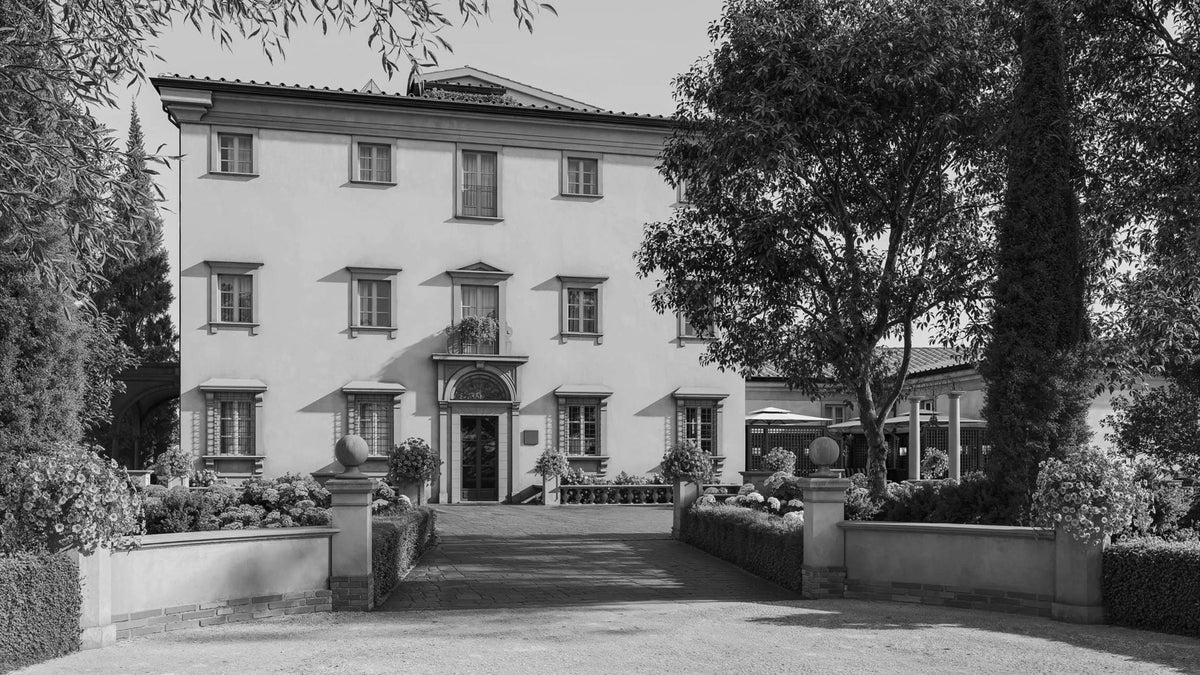
The new hotel occupies a fifteenth-century villa and a constellation of historic outbuildings within five acres of private grounds. Its proposition is less about rural escape than a recalibration of urban time. Florence remains close, yet the sequence of gates, paths, olive trees and shaded rooms allows the day to begin at a different speed.
A villa rather than a viewing platform
Many city hotels understand Florence through spectacle: a rooftop, a bell tower, a carefully framed dome. Borgo Pignano Florence takes another route. Its setting on Via Bolognese is deliberately domestic in character, with eleven buildings arranged as a small borgo rather than a single monumental block. The central villa has been carefully restored, while the surrounding residences, gardens and shared spaces create the sense of an inhabited estate.
This is an important distinction. The best historic hotels do not attempt to compete with the cultural density outside their doors. They establish a credible interior world of their own: one with enough calm, texture and ritual to make returning feel meaningful. Here, the architecture is not a backdrop for constant movement through Florence; it is an argument for pause.
The scale is restrained, with 32 rooms and suites distributed across the grounds. Villa La Sosta, positioned near the entrance, can be reserved as a five-bedroom private residence, with its own garden, pool and separate access. That arrangement gives the property an unusually flexible relationship with privacy. A couple can settle into the life of the hotel; a small party can inhabit a more self-contained version of it.
The patient work of restoration
The restoration was led by Florence-based Studio Ponsi, while the public rooms were conceived by British designer Guy Oliver and the accommodation by Holly Hulburd. Their task was not to produce a historical tableau. Rather, it was to retain the villa’s composure while making it useful for contemporary stays.
Decorated ceilings, stone fireplaces and established proportions remain part of the experience, but the hotel’s character is formed through quieter decisions: natural materials, tailored furniture, Venetian textiles, marble bathrooms and the hand of local makers. Cabinetmakers, metalworkers, stonemasons and decorative specialists were involved in the work, placing craft at the centre of the project rather than treating it as a surface effect.
That approach matters in a city where heritage can easily be reduced to ornament. Borgo Pignano Florence appears to understand restoration as a form of editing. Historic fabric has not been made artificially precious, nor has it been overwhelmed by a contemporary signature. The rooms are intended to hold changing light, long lunches, books left open and the modest disorder of a genuinely lived-in stay.
Gardens as the hotel’s real infrastructure
The most persuasive luxury here may be space. The estate’s gardens move between formal and informal registers: terraces, olive groves, shaded walks and separate planted rooms including the Giardino dei Profumi, Giardino Segreto and Giardino delle Delizie. These are not merely scenic intervals between bedrooms and restaurant tables. They give the hotel its working rhythm.
A walk through planting becomes a transition after breakfast. A terrace becomes the appropriate place for an aperitivo before returning to the city or deciding not to. The 30-metre heated pool, set deeper in the grounds, extends that logic. It is a generously scaled amenity, but its effect is less athletic than atmospheric: water and greenery create distance from Florence’s stone, noise and summer heat.
Wellbeing follows the same measured model. Aromatica Spa includes sauna and hammam facilities, alongside treatments using botanical products developed through the Borgo Pignano estate near Volterra. There is also a fitness area, yoga and paths for private walks or runs. None of this needs to be presented as transformation. It is simply a useful way of restoring attention after a day spent looking.
A city retreat with an agricultural memory
The hotel is the urban sibling of Borgo Pignano’s Tuscan estate near Volterra, and that connection brings an agricultural sensibility to its Florence address. Culinary director Stefano Cavallini oversees the food programme, which includes the Essenza brasserie and Cedrus, a restaurant and bar oriented towards Mediterranean seafood and the garden. Produce, seasonality and the culinary knowledge of the wider estate supply continuity rather than theme.
Even the bars have been given distinct roles. Max Bar nods to the Mille Miglia through period memorabilia, while Oscar Pool Bar takes a lighter place in the day’s sequence. The point is not to make every room perform a separate concept, but to give guests plausible reasons to remain on the property: coffee in the morning, a shaded lunch, a swim, a drink at dusk.
That is the lasting intelligence of Borgo Pignano Florence. It treats privacy not as isolation, but as the ability to choose one’s degree of contact with a city. Florence can still be entered fully and eagerly. Yet there is value in returning to a place where the horizon is softened by trees, where a villa holds the temperature of the afternoon, and where hospitality is shaped as a series of unforced transitions.
For travellers increasingly alert to the quality of time as much as the quality of rooms, this is a convincing direction. The city hotel becomes less a base of operations and more a private culture of its own. This philosophy also informs ILHEMENT’s approach to sartorial resort loungewear.