The Vineta and Palm Beach’s Rehearsed Ease
Palm Beach has always understood that leisure needs structure. Its pleasures are arranged through shade, long walks, carefully kept gardens and façades that keep their composure in the heat. The return of The Vineta Hotel, a 1926 Mediterranean Revival landmark on Cocoanut Row, belongs to that particular tradition. Following an extensive restoration, the former Chesterfield has been brought back under its earlier name as a 41-room hotel: intimate by Palm Beach standards, yet deliberate enough to feel like a proper social address rather than a miniature resort.
The project also marks Oetker Hotels’ first property in the United States. That fact matters less as expansion than as a clue to the approach. The Vineta is not interested in remaking Palm Beach as a Riviera fantasy. It instead works with the local grammar already in place: pale stucco, wrought iron, palms, bougainvillea, courtyards and the quiet theatre of arriving somewhere where the day has been edited rather than over-programmed.
A landmark reduced to its essentials
The hotel’s strongest decision may be spatial. Its room count has been reduced from 57 to 41, allowing the historic footprint to breathe. In a town where size is often treated as a form of status, that reduction reads as an act of confidence. There is more room for thresholds, corridors and the small pauses that make a hotel feel residential: a place for a late breakfast to run on, for a book to remain open, for the return from the beach to become part of the day rather than an interruption to it.
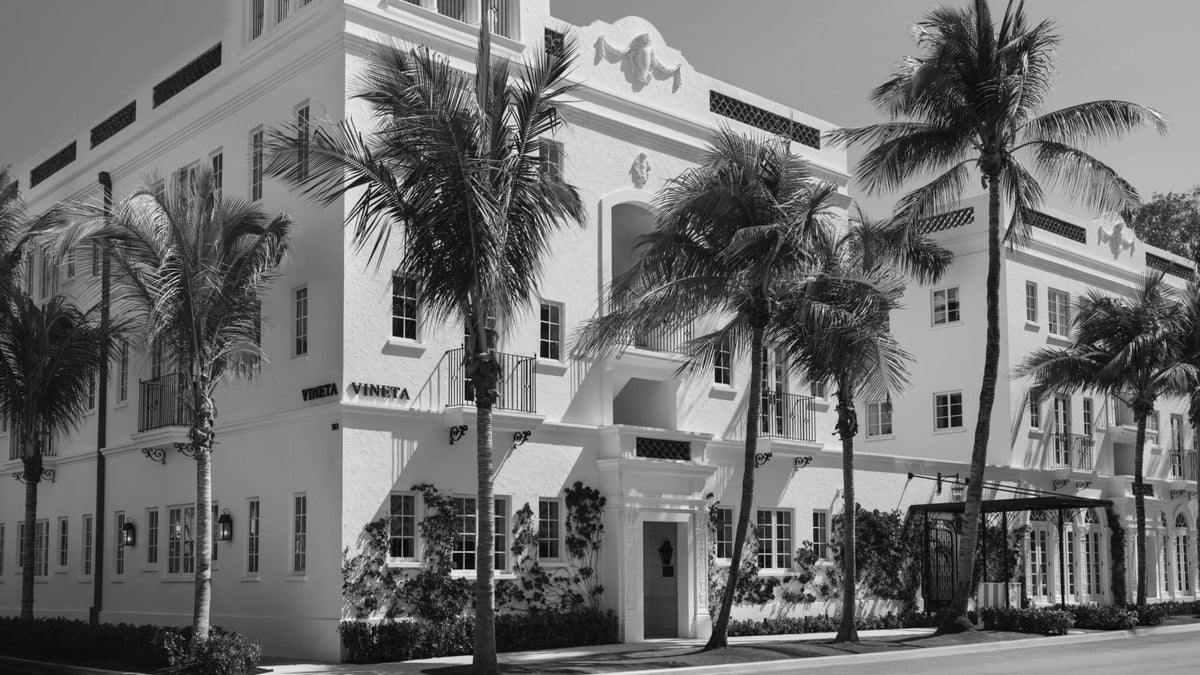
The exterior remains an unmistakable Palm Beach composition. French windows, balconies and a restrained entrance give the building an easy civic presence, while mature planting softens its geometry. It does not perform nostalgia. Instead, the restoration treats the façade as a working piece of town architecture: formal enough to be recognisable, but light enough to belong to streets defined by tropical planting and the proximity of the Atlantic.
That balance is central to the hotel’s appeal. The Vineta is only a short walk from Worth Avenue and the beach, but it does not rely on either for its identity. Its role is more precise: an interior world from which Palm Beach can be entered and re-entered at one’s own pace.
Interior design as a sequence
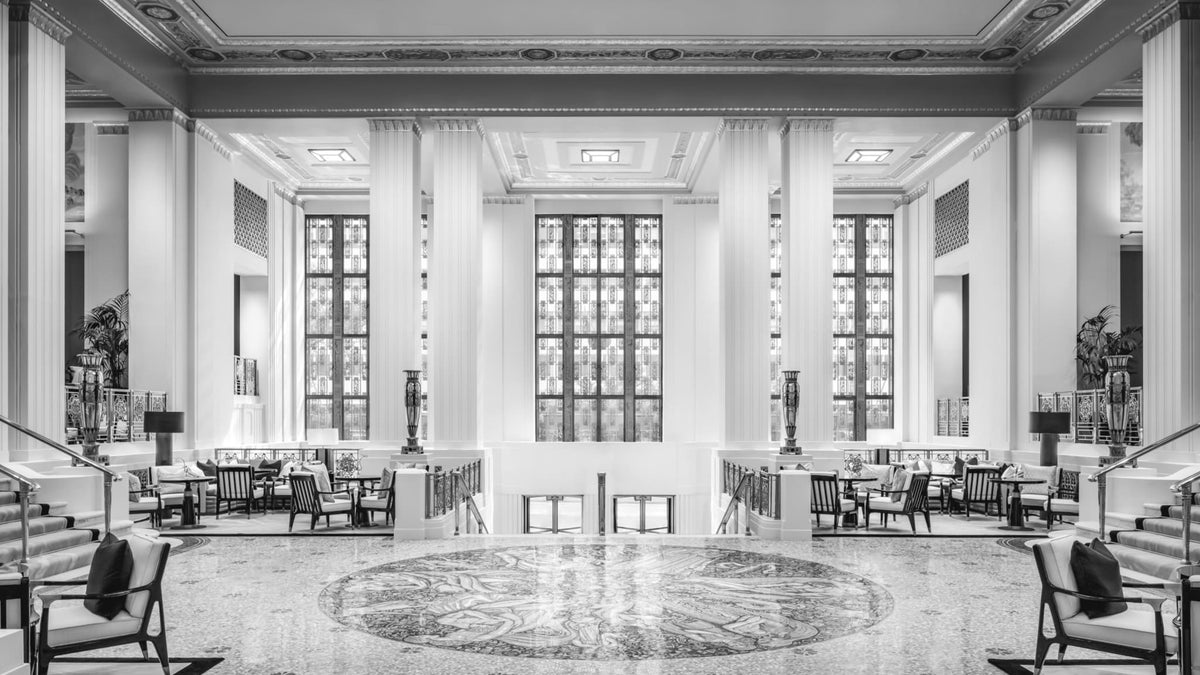
London-based designer Tino Zervudachi has shaped the interiors with a notably architectural understanding of rhythm. Rather than treating each room as a self-contained decorative statement, the public spaces unfold in a sequence. Corridors frame the next room; curved openings temper sightlines; colour and texture guide movement without forcing it. The effect is not grand in the conventional sense. It is closer to the logic of a well-kept private house, where a passageway, a lamp or a change in floor finish can quietly mark a shift in atmosphere.
Across the hotel, terrazzo, rattan, timber, marble and softened plaster establish a material vocabulary that is recognisably coastal without becoming literal. Palm and ibis motifs recur in discreet forms, binding the decorative programme to Palm Beach’s immediate ecology. There are fresco-like touches, scalloped edges and woven elements, but they are held within a controlled palette of cream, blue, coral and green. The details have enough presence to be noticed, yet they do not turn the hotel into a set.
This is where the renovation moves beyond competent preservation. The original building has not been flattened into a generic luxury shell; its asymmetries and scaled rooms become part of the character. The result is a hotel that offers visual interest through accumulation and proportion, not spectacle.
The courtyard as a social room
At ground level, the hotel’s social life is arranged around connected spaces rather than a single oversized lobby. The Bar is deliberately intimate, while Coco’s extends into a courtyard where parasols, climbing greenery and café chairs lend the scene a settled, almost continental cadence. Florentine-made terracotta floors and painted timber trusses make the courtyard feel more constructed than merely landscaped.
That distinction is important. Palm Beach hospitality can sometimes be overly dependent on the pool, the ocean view or the promise of access. The Vineta gives equal weight to the spaces between arrival and departure: a table in filtered sun, an afternoon drink under a ceiling fan, the moment when the temperature changes and the courtyard begins to feel like an evening room.
The pool continues this modestly ceremonial approach. Framed by greenery and scalloped umbrellas, it is not vast, nor intended as a destination in itself. Its appeal lies in its scale and positioning: a private interval within the hotel, visually tied to the architecture rather than separated from it by a standardised deck.
A Palm Beach hotel without the costume
The Vineta arrives at a moment when Palm Beach is being reconsidered beyond its most obvious signals of wealth. The most persuasive new addresses are not those that add the most gloss, but those that understand the island’s enduring visual intelligence: Mediterranean Revival architecture adapted to humidity and light; gardens treated as outdoor rooms; service calibrated to privacy rather than display.
The hotel’s restoration acknowledges this without overplaying its history. A century-old building need not be turned into a museum, nor should a contemporary interior erase the marks that give it its reason for being. The Vineta’s achievement is to make old Palm Beach feel usable again. Its rooms are designed for lingering, its public spaces for understated encounter, and its exterior for the slower pleasure of recognising a familiar silhouette on the street.
Carrying the interval beyond the stay
There is a useful lesson in that sequence of spaces: the move from suite to lobby, courtyard and pool should not require a costume change in attitude. The best resort dressing has the same ease, with enough shape to hold its own in shared rooms and enough softness for the private ones. That measured movement is close to the appeal of sartorial loungewear by ILHEMENT, where Swiss-designed unisex pyjamas consider pleating and generous proportion as tools for crossing between rest and the day beyond it.
The Vineta’s return is ultimately an argument for refinement through editing. It has retained a historic façade, narrowed its scale, built a coherent interior language and allowed Palm Beach’s own rituals of shade, sociability and retreat to do the rest.