Villa San Michele and Fiesole’s Art of Distance
Florence has never lacked for spectacle. Its difficulty, particularly in a crowded season, is finding a place from which the city can be regarded without becoming another participant in its noise. Villa San Michele, high in the wooded hills of Fiesole, has long understood this distinction. Following an 18-month restoration, the historic hotel reopened in spring 2026 with an argument that feels newly persuasive: the most memorable Florentine stay may begin with a little distance.
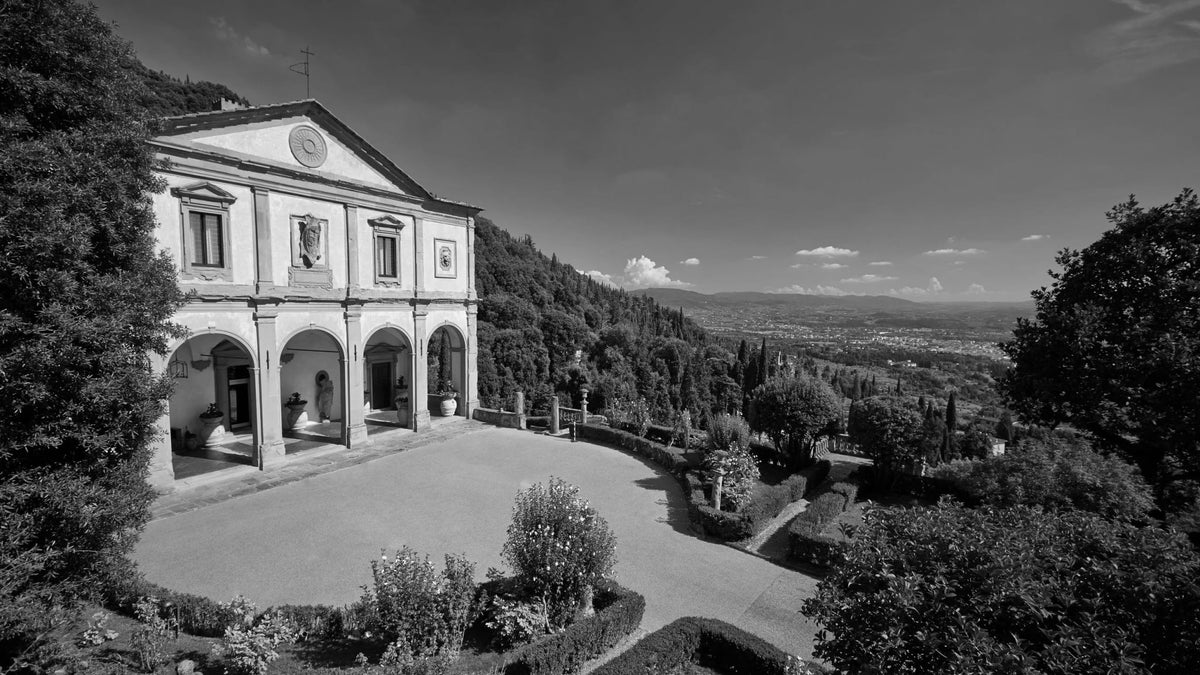
Its setting is not a theatrical escape from the city, but an elevated counterpart to it. The terraces look over roofs, domes and the long basin of the Arno while the building itself holds to a slower, more inward rhythm. Formerly a fifteenth-century Franciscan convent, Villa San Michele has the rare advantage of being architecturally emphatic without needing to announce itself. Its Renaissance façade, traditionally associated with Michelangelo’s circle, frames a sequence of arches, stone thresholds and garden levels that make arrival feel less like check-in than a change of tempo.
A Building Made for Looking Outward
The renewed hotel preserves the tension that has always made the property distinctive: religious restraint on one side, cultivated Florentine sociability on the other. The old convent’s geometry remains legible in its cloister, loggia and cells, but the restoration has resisted the temptation to turn history into décor. Instead, it gives the building’s existing materials and proportions room to register.
The approach to the main house passes through mature planting and terraces held by old stone walls. From there, the view opens gradually rather than all at once. This matters. In Florence, where the panoramic terrace can become a predictable flourish, Villa San Michele makes the landscape part of a longer architectural sequence. A shaded arcade, a garden path and a glimpse through a window are allowed to do as much work as the skyline.
That sequence also clarifies why Fiesole remains an intelligent address. It is close enough to Florence for museums, workshops and dinner, yet physically separate enough to restore the old distinction between the public city and the private house. The hotel’s shuttle makes the practical connection, but its real appeal lies in returning uphill afterwards: leaving the concentration of streets and stone behind for cypress, woodland and the quiet order of the terraces.
Restoration Without Costume
The 2026 renewal was led by Florentine architect and interior designer Luigi Fragola. Across 27 suites and 12 rooms, the approach is deliberately layered rather than uniform. Hand-selected antiques sit with bespoke furniture; local scagliola work and woven textiles introduce material depth without making the rooms feel museum-like. Existing fireplaces and frescoed surfaces were restored or reintroduced with care, retaining the reminder that these spaces once held a very different kind of retreat.
The strongest decision is the refusal to flatten the hotel into one aesthetic. Rooms in the historic building take their cues from its age and formal structure, while garden accommodations are more openly connected to planting, light and the texture of the hillside. This gives the hotel a lived-in variation: not a procession of identical suites, but a collection of rooms with different relationships to stone, foliage and the distant city.
A new spa has been placed within the historic building, while the gardens and woodlands have been renewed as active parts of the stay rather than scenery beyond the window. The result is less an overhaul than an adjustment of emphasis. The Villa now makes clearer use of what was already exceptional: a setting in which interior craft and the cultivated landscape are inseparable.
The Rituals of the Hillside
Villa San Michele is most convincing when it treats leisure as a pattern of small transitions. Mornings may begin in the gardens before the heat gathers over Florence. The pool offers a cooler pause beneath the woodland. By evening, the sixteenth-century loggia becomes a particularly composed place to dine, its arches directing attention outward without reducing the view to a backdrop.
The hotel’s dining spaces also build on this sense of measured movement. Antesi occupies an intimate setting in the Renaissance loggia, while Bar Doccia sits between the historic cloister and the garden, making the aperitivo less of a programmed event than a natural interval between spaces. Here, hospitality is not based on incessant activity. It is based on knowing when to leave the day unfilled.
This is a useful corrective to the contemporary preference for hotels that try to contain an entire destination within their walls. Villa San Michele does not replace Florence; it edits the experience of it. The city remains available, vivid and necessary, but the hotel makes a case for seeing it after a period of stillness, and for returning to the hillside before the evening has fully dissolved.
A Florentine Stay with Breathing Room
The reopening arrives at a moment when heritage hotels are often asked to become louder versions of themselves. Villa San Michele has moved in the opposite direction. It has sharpened its material language, strengthened its links to Tuscan makers and treated its gardens as more than an amenity, while preserving the slightly removed character that has always set it apart.
Its luxury is therefore not reducible to the view, though the view remains extraordinary. It lies in the way the building permits different forms of attention: a restored fresco, the grain of a hand-finished surface, the coolness under an arcade, the gradual descent from suite to garden and then to the city beyond. For travellers who value architecture as something inhabited rather than merely photographed, this is the real proposition.
That movement between privacy and shared space also gives the hotel an apt sartorial parallel. The generous proportions and composed ease of Swiss-designed unisex loungewear suit a day that might move from a quiet suite to the loggia, terrace and the unplanned hours in between. At Villa San Michele, the point is not to dress for display, but to remain at ease within a setting that asks for a little more attention.