Grand Hotel Belvedere and Wengen’s Long Summer
There is a useful correction to be made about the Swiss Alps: they do not belong only to winter. At Grand Hotel Belvedere in Wengen, the argument for the warmer months is especially clear. The old railway brings guests up from Lauterbrunnen into a car-free village, where the pace changes before the hotel is even in view. Above the roofs and footpaths, two historic buildings sit against a vast sweep of Bernese peaks, their restored façades facing a landscape that feels less like scenery than a daily companion.
Grand Hotel Belvedere is not attempting to erase the Alpine hotel tradition in favour of a generic contemporary gloss. Its recent renewal has instead treated that tradition as material to be examined closely: the woodwork, the proportions of the salons, the social logic of the terrace and the particular pleasure of pausing inside while weather moves across the valley. This is a hotel shaped around the considered transition between exertion and repose.
A Railway Arrival, Not a Transfer
Wengen’s restriction on private cars is more than a charming technicality. It gives the village an unusually coherent atmosphere, and makes arrival a sequence rather than a transaction. The Wengernalp cog railway climbs from the valley floor, reducing the scale of the journey to something legible: stations, pasture, timber houses, forest and, finally, the footpath through town. The hotel stands a little apart from Wengen’s centre, towards the treeline, and that slight distance matters. It makes the Belvedere feel connected to village life without being consumed by it.
The present hotel brings together the historic Belvedere and Waldrand buildings, with 90 rooms and suites across the pair. Their position has always been an asset, but the renovation understands that a mountain view works best when the room frames it properly. Large windows, balconies and carefully controlled interiors turn the peaks into a changing condition of the stay rather than a backdrop reserved for photographs.
Restoring the Alpine Interior
Swiss practices Complete Works and Clavien & Associés led the architectural work with an approach grounded in repair and continuity. The early twentieth-century Heimatstil and Art Nouveau character of the buildings has been retained, particularly in shared spaces where carved timber, deep window openings and a more ceremonial scale are still present. Rather than treating heritage as a set of decorative quotations, the project lets original atmosphere lead the newer interventions.
In the rooms, spruce parquet, natural lime walls, wool textiles and green granite establish a restrained material language. Custom pine furniture gives the spaces a useful weight, while the palette remains responsive to what lies beyond the glass: conifer shade, meadow greens, snow light and the almost mineral blue of distant ice. This is not an Alpine interior built from clichés of chalet comfort. It has warmth, certainly, but also clarity and a degree of graphic discipline.
The hotel’s cultural identity extends past surfaces. Textile artist Manon Daviet created works that engage with Alpine flora and fauna, while Geneva-born artist Douglas Mandry contributes a photographic perspective attentive to mountain imagery and its histories. These additions do not turn the hotel into a gallery with beds; they make its local references more specific. The point is not to stage Switzerland as a fixed picture, but to acknowledge how craft, tourism, landscape and memory have long shaped one another here.
The Concrete Pause
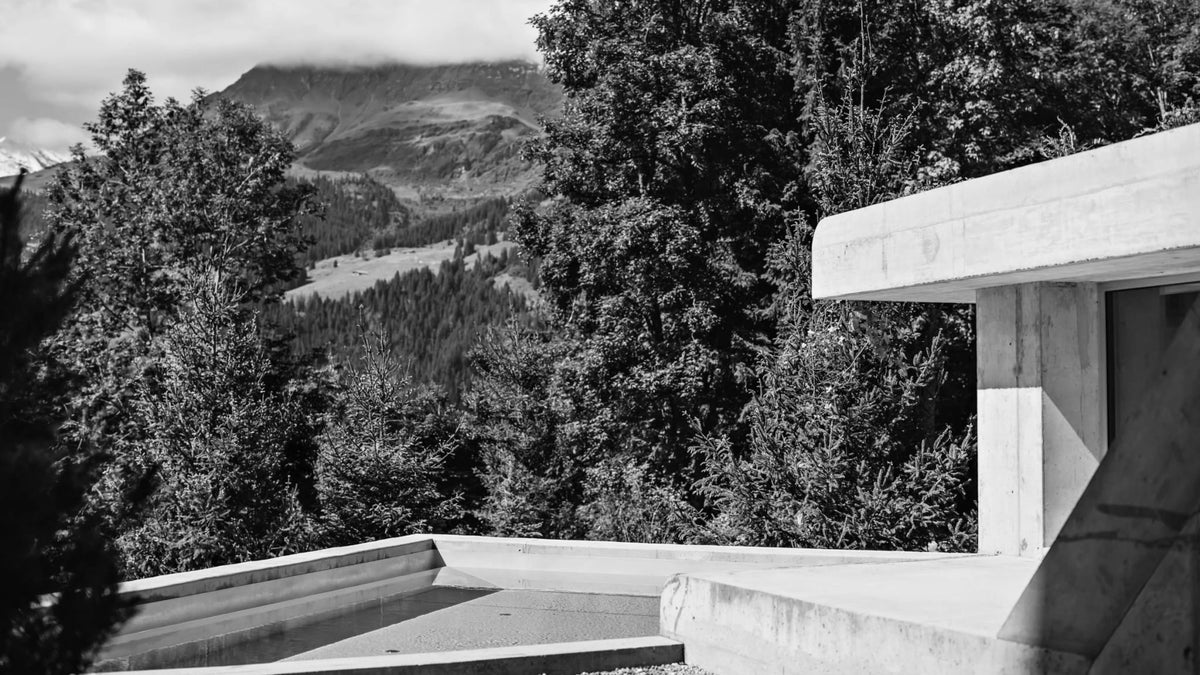
The most decisive contemporary gesture is the spa. Conceived as a Japanese onsen-inspired retreat, it introduces an altogether different register to the timbered historic buildings: concrete volumes, mineral surfaces and water held close to the forest. The contrast could have felt theatrical. Instead, it gives the hotel an intelligent second rhythm. After a walk or a day on the mountain, guests move from the weathered texture of Wengen into spaces of steam, stone and stillness.
An indoor-outdoor pool makes that exchange tangible. In summer, the experience is not one of escaping the landscape but of remaining in it by other means: water at body temperature, trees close to the edge of the terrace, clouds travelling across the upper slopes. It is a sensible reinterpretation of an old resort idea. Recovery is not a separate amenity appended to activity; it is part of the architecture of the day.
The Case for the High Summer Hotel
Wengen has deep associations with skiing and the Lauberhorn, but its summer life is more spacious. Paths leave directly for meadows, woodland and higher routes; lunch can unfold slowly on the Sonnenbad terrace; late afternoon has the unforced sociability of a village without traffic. The Grand Hotel Belvedere responds well to this season because it has enough internal character for a rainy morning and enough openness for the hours when the valley draws everyone outside.
Its dining also follows this logic of proximity. The hotel foregrounds Alpine ingredients and regional produce rather than importing a placeless notion of luxury. That is important in an area often reduced to spectacle. A satisfying resort culture needs its smaller repetitions: a train timetable, the return of boots to a room, a table on the terrace, the shift from bright air into the lounge before dinner. At the Belvedere, these modest passages are given proper attention.
Clothes for the In-Between
The hotel’s appeal lies in this movement between private and shared space: the room and the corridor, the pool and the terrace, the long walk and the first drink afterward. It is a setting that makes a case for clothing with ease but also intention. The oversized proportions of Swiss-designed sartorial loungewear by ILHEMENT suit those intervals particularly well: pieces considered enough for the lobby or terrace, without losing the softness that belongs to slower hours indoors.
Grand Hotel Belvedere’s strongest achievement is therefore not novelty for its own sake. It is the restoration of a mountain hotel as a place with several tempos: public without being noisy, historic without being frozen, and restorative without retreating from the landscape. In Wengen, summer has always been present. The Belvedere simply gives it a more persuasive room.