Orient Express Venezia: A Venetian Palace Reawakened
Venice has never lacked grand façades, yet its most persuasive interiors have always been those that withhold themselves. They appear only after a turn from the crowded fondamenta, a modest door or a water gate that gives little away. Orient Express Venezia, newly installed in Palazzo Donà Giovannelli in Cannaregio, understands this old Venetian principle. Its arrival is not designed as spectacle alone, but as a gradual adjustment of pace: boat wake subsiding on the canal, stone underfoot, a sheltered court, then rooms in which the city’s accumulated layers are allowed to speak.
The hotel’s recent opening brings a 15th-century palace into hospitality for the first time in its long history. It is a meaningful development in a city often caught between preservation and performance. Rather than stripping the building into an abstract idea of luxury, the restoration treats its irregularities, ornament and changing identities as the essential material of the stay.
A palace built through time
Palazzo Donà Giovannelli was built in 1436, during the Venetian Republic, and later belonged to the Donà and Giovannelli families. In the 19th century, architect Giovanni Battista Meduna reshaped parts of it with a highly theatrical Neo-Gothic vocabulary: an octagonal staircase, richly worked reception rooms and an exterior that once carried a distinctive pink-and-white chequered finish. The palace also served as a picture gallery before its present incarnation, adding another layer to an address already marked by domestic, social and cultural lives.
The restoration, led by architect and interior designer Aline Asmar d’Amman, took eight years. This duration matters. Venetian buildings do not respond well to haste: water, salt, settlement and centuries of alteration require a patient reading of every surface. Original frescoes, carved timber, stucco, stone and decorative elements were treated as evidence rather than obstacles. The result is not a frozen historical interior, nor a sharp contemporary counterpoint, but a composed exchange between the two.
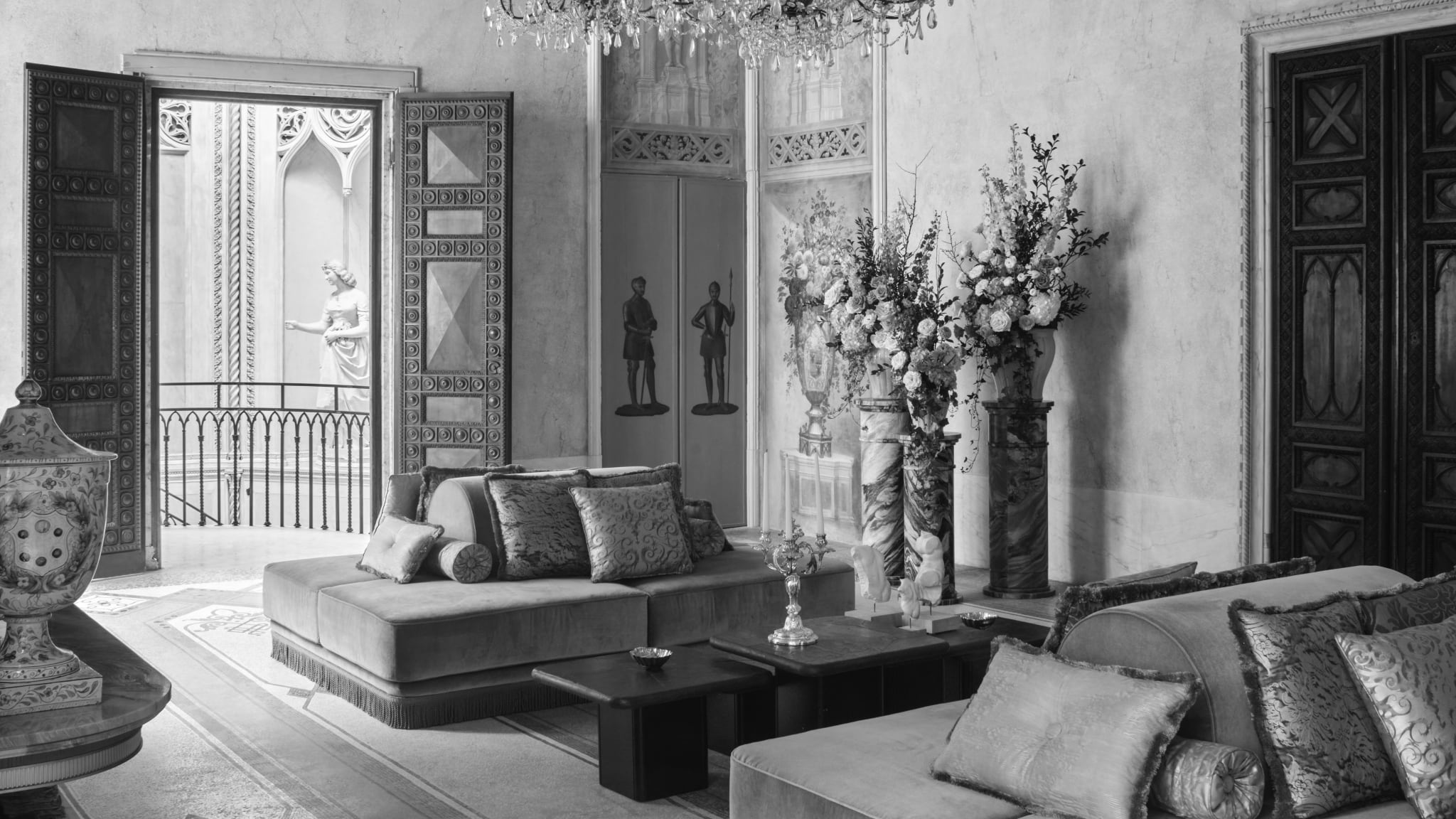
That exchange is clearest in the public rooms. A lofty court-like lobby gathers marble columns, palms, Murano glass and richly upholstered seating without allowing any one element to become overly emphatic. Elsewhere, faded blues, mineral pinks, ochres and greens revive the sense of colour that Venice’s weathered façades often conceal. These are not decorative gestures detached from place. They draw on the city’s long relationship with pigments, glass, silk, maritime trade and the particular reflected light of the lagoon.
The importance of a measured arrival
In contemporary hospitality, privacy is frequently described through square metres and restricted access. At Palazzo Donà Giovannelli, it is more architectural than numerical. Cannaregio, though central, remains less ceremonially exposed than the lanes around San Marco. The palace has both a landward entrance and a water entrance, allowing the guest to choose between the everyday Venice of neighbourhood streets and the older, more dramatic language of the canal.
This duality gives the hotel its particular atmosphere. Arrival by boat is not merely a picturesque transfer but a reset of scale. Water places the building in sequence with the city rather than apart from it; the façade rises directly from the canal, and the interior unfolds as a set of thresholds rather than an instant reveal. Such spatial pacing has become rare. It creates a form of emotional luxury that has little to do with excess and much to do with the feeling that one has crossed into a more protected order.
The hotel’s 47 rooms and suites are accordingly less uniform than the contemporary hotel norm. Six Signature Suites preserve especially expressive historic features, including painted ceilings, stucco work and monumental fireplaces; the largest extend to 145 square metres. Yet the quieter rooms are equally important to the project’s rhythm. Here, pale timber, restrained fretwork and softer, more enveloping tones temper the splendour of the palazzo. Rest is not treated as an afterthought to heritage, but as its necessary counterpart.
Craft as an atmosphere
Venice’s decorative arts can easily become theatrical shorthand. The achievement here is that craftsmanship feels structural to the rooms, rather than applied as a catalogue of local references. Murano glass has presence, but so do the less immediate pleasures of gilding, patterned stone, watered silks, aged plaster and the subtle unevenness of restored surfaces. The eye is given enough to follow, then enough quiet to settle.
This is also why the building avoids the mood of a museum. Historic rooms are made habitable through proportion, comfort and use. There are places for an unhurried breakfast, a late aperitivo or a private conversation away from the city’s public theatre. Dining extends into courtyards and gardens, while the planned spa draws on Roman bathing traditions, Venice’s maritime character and the enveloping rituals of the hammam. The references are broad, but the intention is intimate: to bring the body back into a building whose history might otherwise be experienced only visually.
The walled garden is perhaps the most quietly radical part of the proposition. Gardens are scarce in this dense part of Venice, and the presence of one changes the emotional register of a stay. It offers shade, distance and a place where the city’s watery movement is exchanged for the slower attention of leaves, stone and evening light. In a destination increasingly shaped by crowds and itineraries, the ability to remain somewhere—without needing to be entertained by it—has renewed value.
Living with ceremony
Orient Express Venezia makes a persuasive case for hospitality as a form of stewardship. It neither disguises the palazzo’s gravity nor turns it into a stage set. Instead, it suggests that historic buildings can remain socially alive when their restoration respects both material truth and contemporary rituals of repose. A drink in a small bar, a return through the garden after dinner, a morning spent looking at canal traffic from a tall window: these are modest occasions, but they are made memorable by the rooms that contain them.
For the guest, the lesson is not to imitate Venetian grandeur, but to recover a more deliberate relationship with time and comfort. A well-made robe, a soft knit, a book left open beside a window and the permission to pause can be as integral to a stay as any formal itinerary. This philosophy also informs ILHEMENT’s approach to sartorial resort loungewear: clothing conceived not for display, but for the considered intervals in which a place gradually becomes one’s own.
In Venice, where nearly every building bears the weight of being seen, Palazzo Donà Giovannelli offers something more valuable: the sense of being received. Its restoration does not ask the past to perform. It allows it, with tact and considerable skill, to become a setting for the present.