The Ocean Club and the Discipline of Paradise
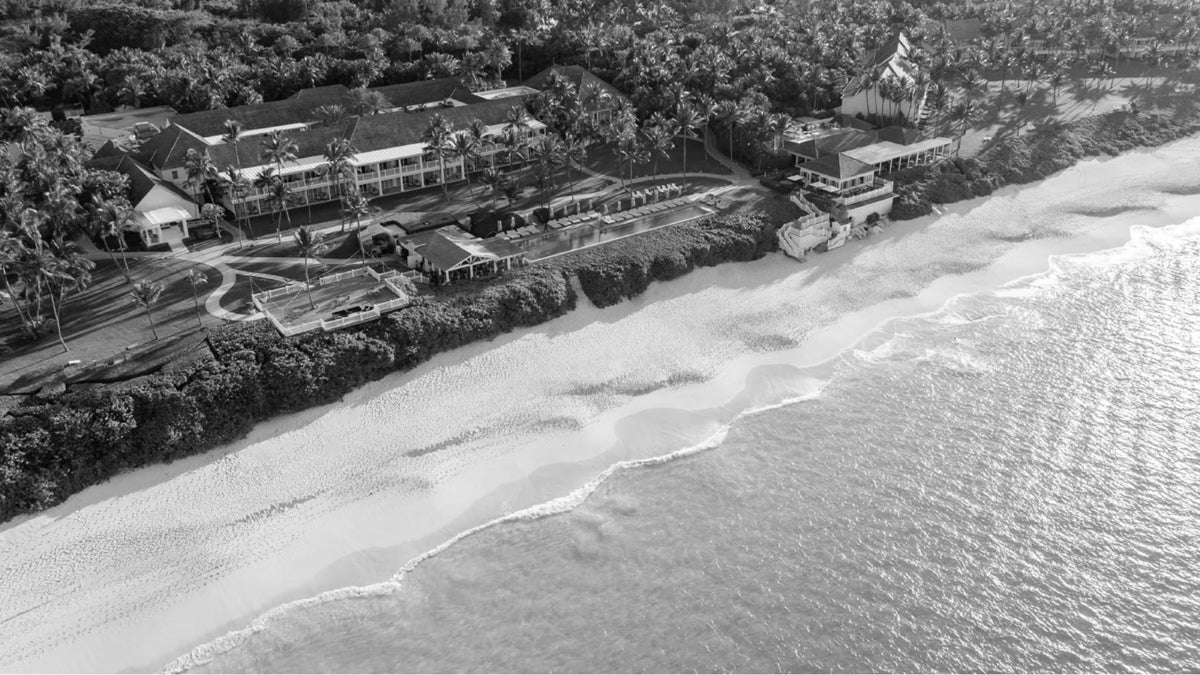
Paradise Island is not ordinarily associated with restraint. Its name alone promises spectacle, and the wider Bahamian resort landscape often obliges with it. The Ocean Club has always held another line. Set behind a long sweep of pale beach and palms, the property remains a place of studied composition: formal gardens before the sea, low-slung colonial-era architecture, a bar shaped for the unhurried late afternoon, and an understanding that privacy is best built into a landscape rather than announced.
Its latest development is modest in scale but revealing in intent. The resort’s Hartford Wing, the original accommodation wing opened in 1962, has been reworked across 26 ocean-view guestrooms and two suites. The new rooms were announced for stays from 8 October 2026, following the property’s seasonal closure. Rather than turning the update into a departure, the redesign treats the wing as an opportunity to refine the established conversation between ordered interiors, the palm-lined courtyard and the Atlantic beyond.
A resort built around sequence
The Ocean Club began as the private estate of Huntington Hartford II, heir to the A&P fortune, before becoming a hotel in 1962. Hartford’s collecting instincts shaped the property’s most distinctive cultural gesture: the Versailles Gardens, a formally arranged landscape of statuary, terraces and fragments of medieval French cloister brought into a tropical setting. It is an improbable proposition, certainly, but its importance lies in the way it gives the resort a spatial rhythm unavailable to most beach hotels.
One does not arrive directly at the water. Instead, the experience moves through thresholds: the garden axis, clipped planting, stone stairs, shaded paths and pools before the beach reveals itself. The Atlantic becomes a culmination rather than a backdrop. That sequencing has helped The Ocean Club keep its identity through successive eras, including its earlier life as the One&Only Ocean Club and its current operation under Four Seasons.
Architectural Digest described the Hartford Wing’s 2016 renovation as an exercise in preserving the character of the former private estate while making the rooms more spacious and outward-looking. That balance remains useful now. A resort can update its comforts without losing the small tensions that make a place memorable: stone against vegetation, European formality against humid air, the controlled geometry of a garden against the open horizon.
The Hartford Wing’s quieter revision
The 2026 refresh is led by Palm Beach-based designer Joanna Kerr. Its language is intentionally light: pale surfaces, warm greige oak, chocolate-toned wood, woven pendant lighting, patterned textiles and stone that draws from sand, shells and moving water. Linen-like blue wallcoverings replace the wing’s darker wood panelling, while new tile floors and wave-patterned bathroom stone bring a more coastal register to the rooms.
Yet the meaningful decision is not the palette. It is the effort to retain symmetry and structure within it. Mirrored details at headboards and television walls keep the rooms from dissolving into generic beach-house ease; woven rugs take their motif from the Hartford courtyard; black-and-white photography folds the hotel’s social history back into the guest experience. The result, on paper at least, is not an attempt to make the resort younger. It is a calibration of its original vocabulary for longer, more private stays.
The Hartford Wing is also close to the lobby, the Martini Bar, the spa and the principal garden routes. This makes it an especially useful part of the property through which to consider resort life as a sequence of shared and private rooms. A terrace breakfast can lead to a walk through the gardens; an afternoon on the lawn or by the Versailles Pool need not preclude an evening drink under a roof. The day is not organised around an itinerary so much as a measured change of setting.
Why the garden still matters
The Ocean Club’s most persuasive feature remains its refusal to treat the beach as its only asset. The Versailles Gardens introduce duration into a coastal stay. Their stones, sculpture and formal planting ask the guest to slow down, look sideways and accept that the resort’s centre of gravity is not solely recreational. The gardens are theatrical, but their theatricality is disciplined by repetition: a path, a step, a water basin, an avenue of palms.
That is also why the new Hartford rooms make sense as an editorial development. The materials described in the redesign are not abstract gestures towards luxury. Basketweave mosaics, made-to-measure rugs, tailored joinery and intentionally placed colour all work best when they sharpen the passage between inside and out. In a property with such a specific exterior world, an interior needs to act as a composed interval rather than compete for attention.
This is a useful distinction for coastal hospitality more broadly. The most lasting resorts do not depend on endless novelty. They make a case for return through proportion, shade, service and ritual. A well-positioned chair in a courtyard, a quiet route from room to sea, or a bar that understands the value of a pause can outlast the visual drama of an arrival lobby.
Clothes for the interval between rooms
The Ocean Club’s renewed Hartford Wing suggests a style of resort living that is neither fully public nor completely withdrawn. It is about dressing for the interval: leaving a cool suite for the garden, crossing the lawn for lunch, returning through the lobby without needing to change one’s entire register. That movement asks for ease with enough structure to remain intentional.
It is the kind of setting in which sartorial resort loungewear can make quiet sense: Swiss-designed unisex pyjamas with generous proportions or considered pleating that hold their line from suite to terrace and, later, into everyday life. The point is not to make leisure performative. It is to preserve some of the hotel’s discipline after departure: the pleasure of moving slowly, well dressed, through more than one room.
At its best, The Ocean Club offers a lesson in exactly that discipline. The refreshed Hartford Wing may introduce lighter surfaces and a new material register, but the larger proposition remains intact. Here, paradise is not delivered through excess. It is edited through gardens, proportion and the long, civilised distance between the door and the sea.