Mazzarò Sea Palace and Sicily’s Material Memory
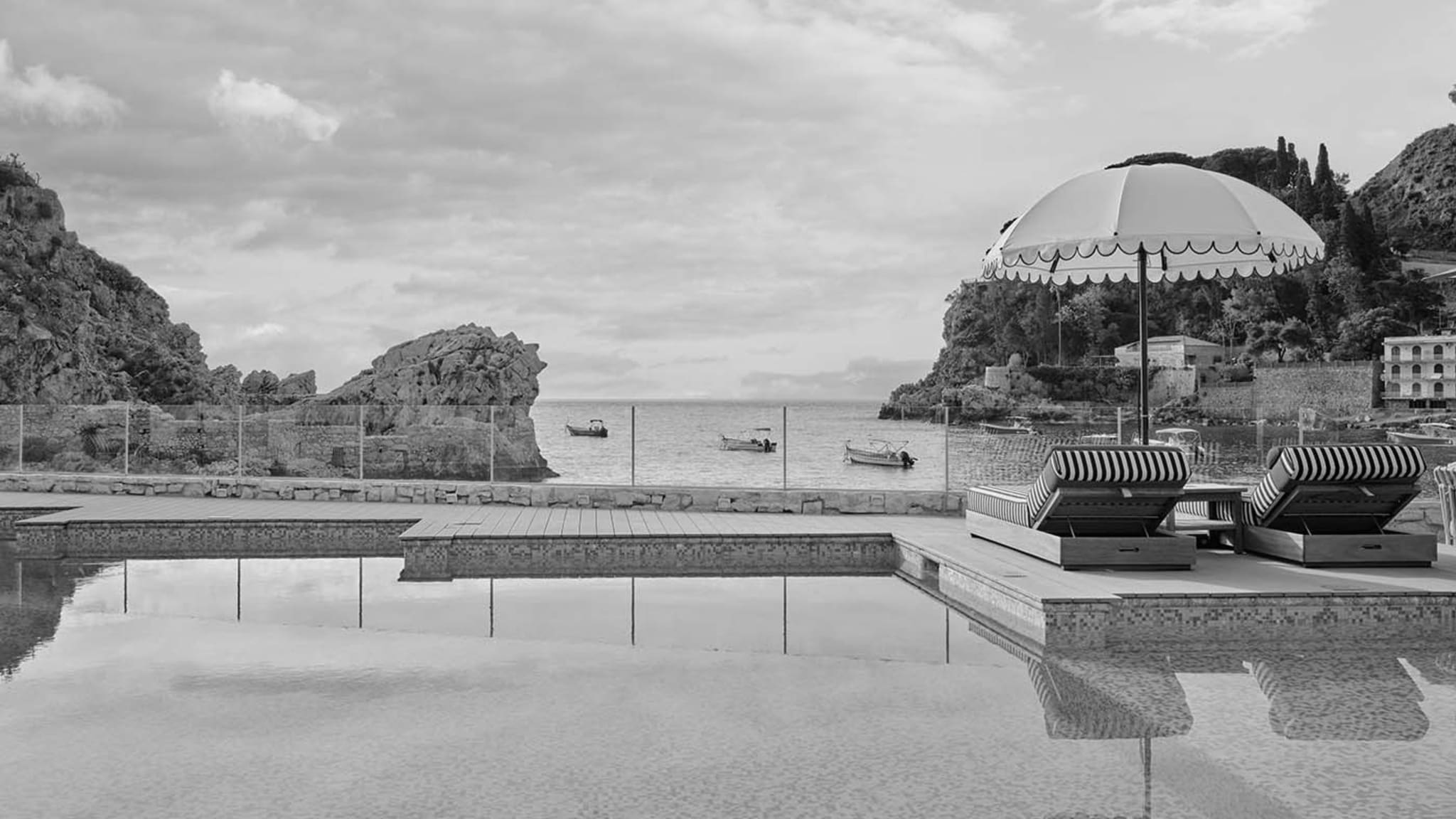
There are coastlines that invite decoration, and others that insist upon a more exacting response. The Bay of Mazzarò, below Taormina, is one of the latter. Its enclosing rock, luminous water and tightly held horizon leave little need for theatrical invention. The 2026 redesign of Mazzarò Sea Palace understands this. Rather than competing with the Ionian view, it returns attention to the materials that give eastern Sicily its particular visual weight: lava stone, hand-worked ceramic, lime plaster, timber, leather and the changing blue of the sea.
Completed this summer by the architecture and design studio De.Tales, the renewal reaches from the guest rooms into the arrival spaces, restaurants, bars, private beach and panoramic terraces. Its achievement is not novelty for its own sake, but a greater sense of continuity. The hotel now feels less like an interior placed beside a bay and more like a composed extension of it.
A bay with its own architecture
Mazzarò is not Taormina’s formal, elevated stage. It is the lower, more enclosed counterpoint: a narrow sweep of water contained by steep vegetation, rock and the occasional historic villa. The approach has an intimacy that changes the terms of a resort stay. One arrives close to the sea rather than above it; the horizon is present, but never abstract.
This physical condition gives the hotel’s renewed public rooms their direction. The reception area is organised to draw the eye outward, with a radial floor pattern and a sculptural desk in lava stone and hand-woven blue leather. Such details are not merely decorative references to place. They establish a useful measure of density against the lightness of the water beyond. The eye moves from a tactile surface to an open expanse, then back again.
That rhythm matters. Too many coastal interiors treat the view as an excuse for visual absence: pale surfaces, anonymous furniture and expanses of glass intended to dissolve the room altogether. Here, the design permits the interior to remain a room. It has grain, shadow and a sense of shelter. The sea is framed rather than consumed.
Matter before spectacle
The most persuasive strand of the redesign is its attention to Sicilian material culture. Lava stone appears in furniture and surfaces, giving the rooms and public spaces a grounded, mineral note. Bespoke ceramics introduce a quieter counterpoint: a slight irregularity, a change in glaze, the evidence of the hand. Lime plaster softens walls, while timber and woven leather prevent the palette from becoming too austere.
These choices draw on an island where geology is never remote. Mount Etna is visible from much of this coast, but its presence is also felt in the dark volcanic stone that has long shaped local building and domestic objects. At Mazzarò Sea Palace, that connection is handled with restraint. Lava is not made into a theme. It is used as a material with depth, porosity and tonal variation, especially effective beside sun-bleached neutrals and the deep marine blues that recur through the scheme.
The guest rooms develop this thinking most intimately. Soft vaults form alcove-like sleeping areas, giving the beds a protected, almost domestic character. Organic forms and private terraces sustain a relationship between inside and out, but without turning every room into a stage set for the view. It is a small but important distinction. Privacy in a resort is not simply a matter of square metres; it is the feeling that one can withdraw from the panorama without leaving the place.
Hospitality at the pace of the coast
In a good Mediterranean hotel, rituals are often spatial before they are ceremonial. Breakfast needs shade and an unhurried prospect. The late-afternoon drink requires a room that catches the changing colour of the water without demanding an audience. Dinner should allow the coast to recede into darkness at its own pace.
The revised dining spaces respond to this sequence. Armònia is arranged as an indoor-outdoor restaurant, with curved forms and handcrafted ceramic elements carrying the eye towards the bay. Almarè Bar turns to local ingredients and Etna wines, while the Velvet terrace gives the aperitivo its proper temporal place: after the day’s heat, before the night’s meal. Blum, the hotel’s more enclosed restaurant, offers a deliberately different register, with marine textures, lime-plastered walls and lava-stone tables creating a quieter setting after sunset.
These are not separate attractions competing for attention. They create an evening with gradations. The essential luxury is not abundance but the ability to change one’s mood without having to change one’s surroundings. A terrace, a bar, a table by the water, then an interior with a little more shadow: the hotel allows the day to lengthen naturally.
The value of a bounded view
Contemporary resort architecture can be overly preoccupied with seamlessness. Every threshold is erased, every room becomes open plan, and privacy is confused with exclusion. Mazzarò Sea Palace takes a more cultivated approach. Its new spaces move fluidly, certainly, but they remain legible. The lobby is a place of arrival. The terrace is a place for looking outward. The rooms offer retreat. The beach and pool draw the body closer to the elements.
That clarity makes room for emotional ease. Guests do not need to be entertained by the architecture because it quietly supports the tempo of a stay: a swim before breakfast, reading in the hour when the bay is brightest, an unplanned pause at the bar, a return to one’s room while there is still warmth in the stone. The design works because it gives each of these moments an appropriate setting.
This is the more enduring promise of the new Mazzarò Sea Palace. It does not attempt to invent a version of Sicily that can travel elsewhere. It relies instead on the island’s durable language of mineral surfaces, filtered light, artisanal detail and measured hospitality. In doing so, it proposes a resort life shaped less by display than by touch, proportion and the comfort of being near the sea. This philosophy also informs ILHEMENT’s approach to sartorial resort loungewear: ease becomes most convincing when it is grounded in material, movement and place.