Gran Hotel Margalida and Mallorca’s Terraced Art of Rest
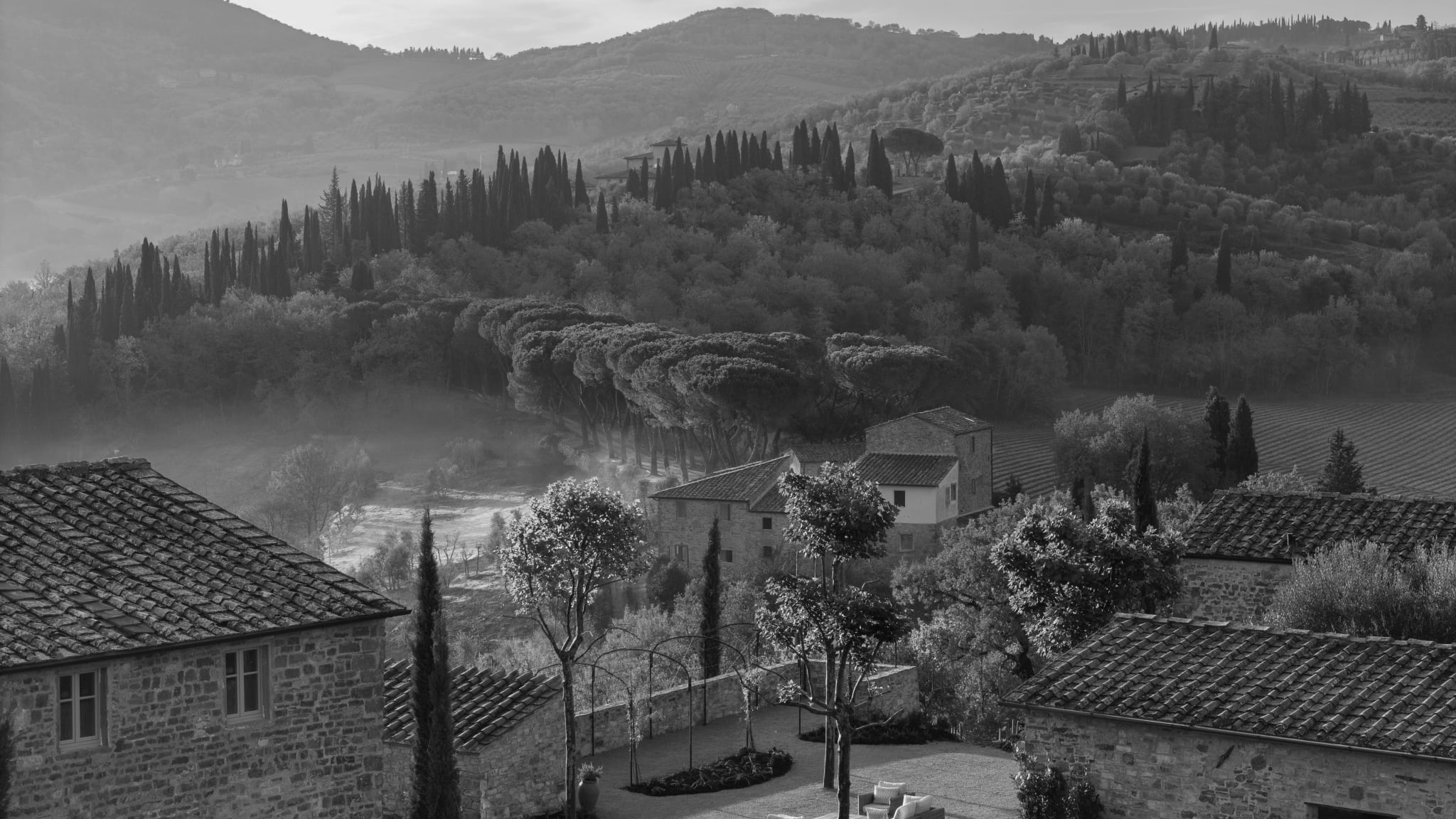
On Mallorca’s western coast, the approach to Banyalbufar is deliberately slow. The road folds through the Serra de Tramuntana, passing dry-stone walls, small vineyards and terraces that seem to have been drawn down the mountainside towards the sea. It is a landscape made by persistence rather than display. The new Gran Hotel Margalida, which opened this summer above the village, understands that its most convincing gesture is not to compete with this setting, but to take its measure from it.
With 29 sea-facing rooms and suites, the hotel occupies a hillside position between mountain and water. Its arrival adds a considered address to a part of Mallorca that has long retained a more agricultural, inward-looking character than the island’s better-known coastal resorts. Here, the allure lies in containment: the way a wall makes shade, the quiet between one terrace and the next, and the western light that lingers over the Mediterranean at the close of day.
A hotel shaped by the bancales
The defining architectural reference is the bancal: Mallorca’s centuries-old system of cultivated terraces. These retaining walls are acts of practical beauty, holding soil in place on steep terrain while establishing a sequence of usable ledges. At Gran Hotel Margalida, this logic informs the guest experience. Rather than presenting a single grand façade, the property is read in layers, with paths, planting and outward-facing spaces unfolding gradually through the slope.
The architecture, led by Álvaro Onieva with Estudio Mesonero Romanos, uses lime-rendered surfaces, reduced volumes and Mediterranean planting to connect the building to the hillside. Cypress, wild olive and strawberry trees accompany dry-stone routes; stepped gardens continue the territorial language of the village. It is not an argument for rustic nostalgia. The project is contemporary in its planning and comfort, but it recognises that on this coast, architecture needs to sit low, accept the force of the sun and allow the landscape to remain the principal presence.
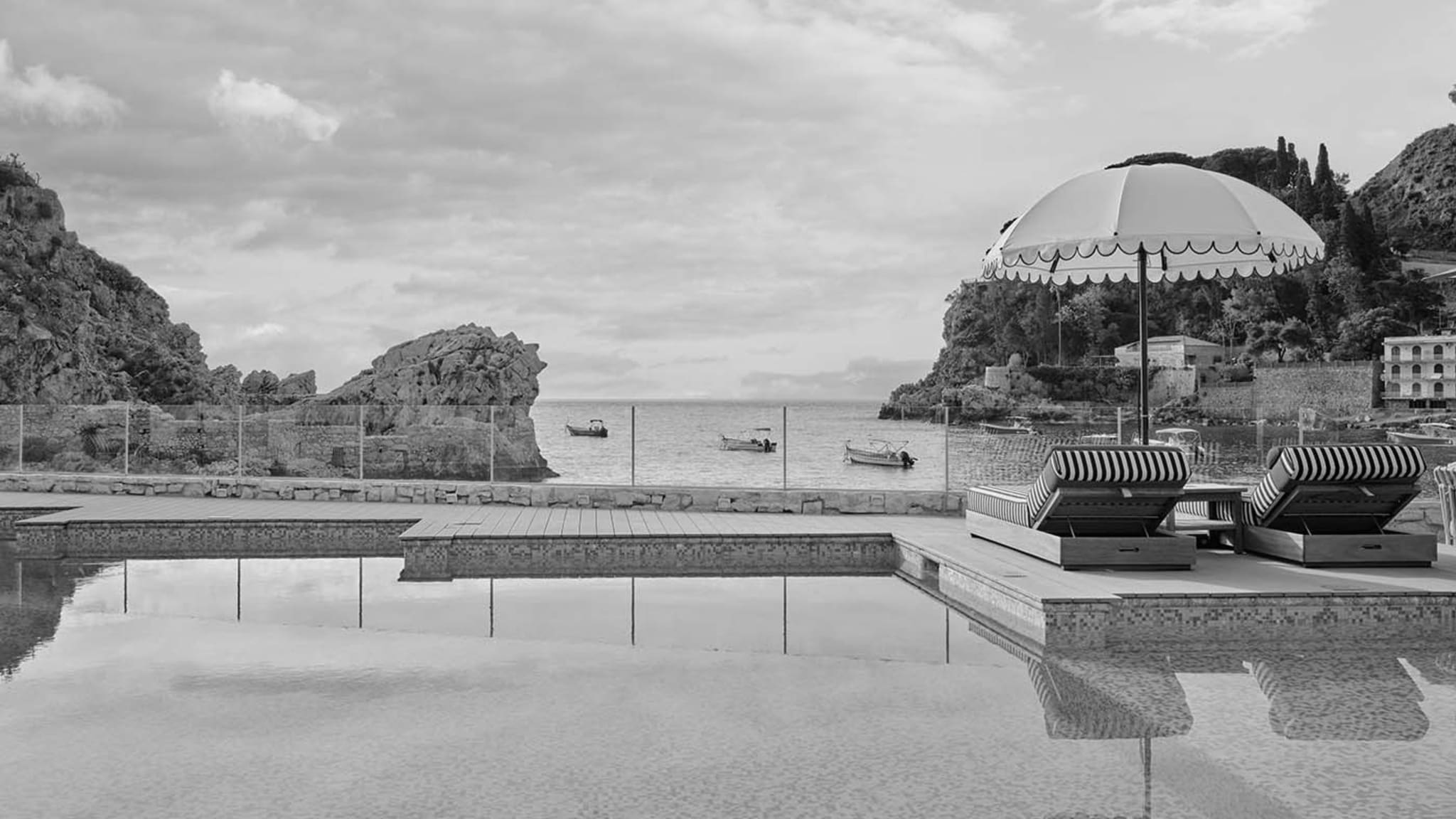
This is an important distinction in a destination too often interpreted through detached villas and panoramic spectacle. Banyalbufar asks for another pace. The hotel’s terraces are not merely platforms for looking outward; they make the descent towards the sea legible. Their succession gives a stay a physical rhythm: room, passage, shade, water, horizon. The infinity pool is consequently less a standalone amenity than a final edge in a larger composition of levels.
Interiors with a sense of temperature
Inside, the rooms have been conceived as private coastal apartments rather than decorative holiday sets. Virginia Nieto’s interiors draw together natural textures, hand-finished cabinetry, curved furniture and details that reference the confidence of Mediterranean interiors from the 1960s. The palette is restrained but not neutralised: a warm yellow, informed by mountain honey and mimosa, appears as an accent against stone, timber and the changing blue beyond the windows.
The decision to give every suite an open sea orientation matters. In a small hotel, privacy is often a consequence of scale, but it must also be designed. Generous sightlines, private terraces in selected categories and the absence of visual clutter allow the rooms to operate as places for retreat, not merely recovery between excursions. The sea is present, but it is framed rather than overperformed.
Traditional Mallorcan llengua fabric appears within the rooms, bringing a local graphic vocabulary to the scheme without turning craft into ornament. Its characteristic flame-like pattern has long belonged to domestic island interiors; here it sits alongside bespoke pieces and clean architectural lines. This measured combination is one of the hotel’s strengths. It acknowledges regional material culture while leaving space for contemporary life: an early coffee in the room, a book placed aside before a swim, the slow reassembly of one’s day after the heat has passed.
The rituals of a west-coast stay
Good resort culture is built less on programmes than on rituals that feel inevitable to their setting. At Gran Hotel Margalida, the most persuasive of these is sunset. Banyalbufar faces west, and the hotel’s terraces turn the last light into a daily interval rather than a special event. A bath facing the horizon, an aperitif beneath the cypresses, or simply the decision to remain still as the mountain darkens behind the village: these are modest ceremonies, but they restore proportion to a day.
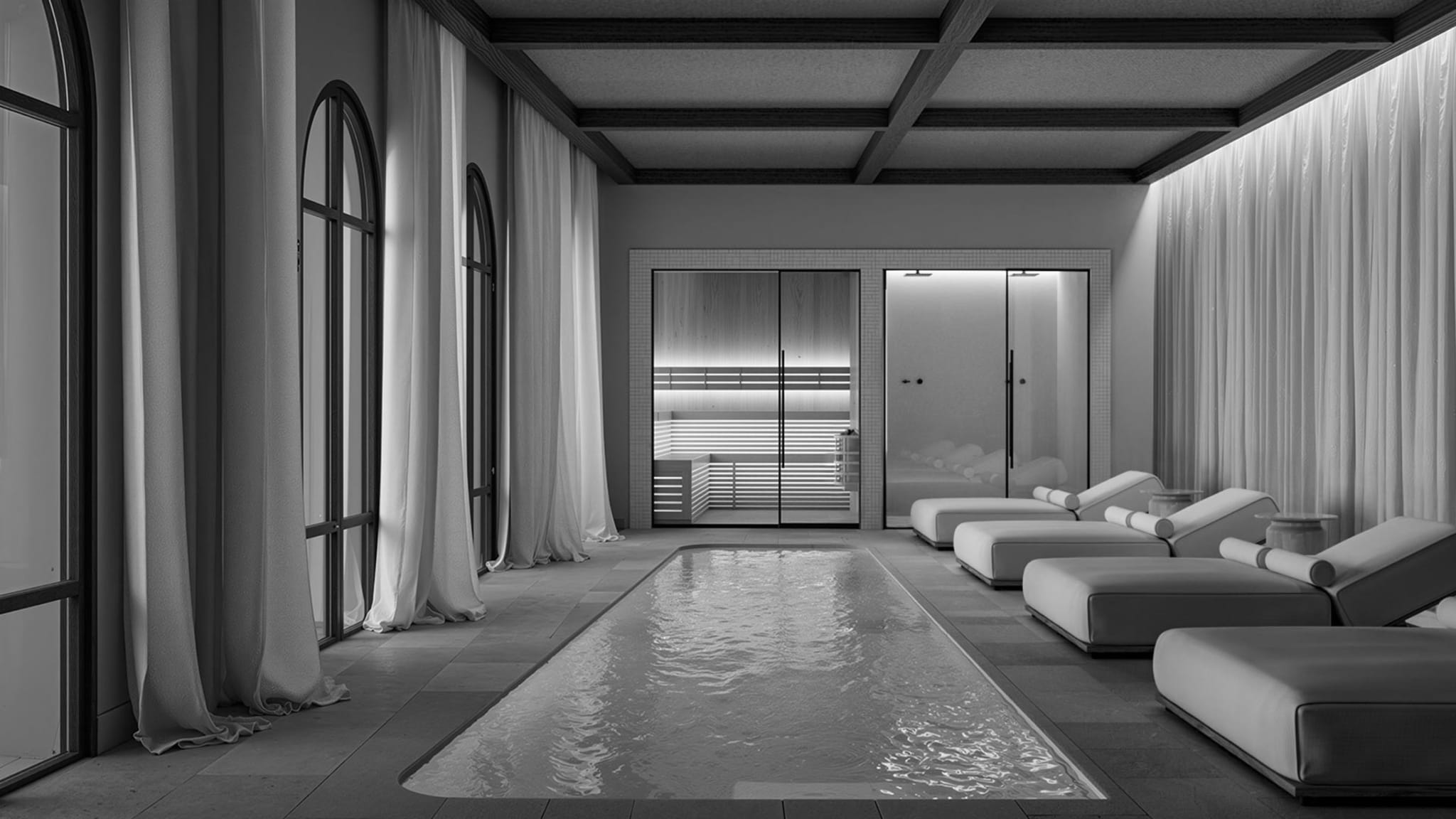
The wellness spaces extend this idea of rest without making it overly technical. The lower-level spa includes hydrotherapy, steam and treatment rooms, while a movement studio, Reformer Pilates and an outdoor yoga platform create options for exertion that remain connected to the terrain. The point is not optimisation. It is to make physical ease part of the architecture of the stay: a swim before breakfast, a stretch after walking the slopes, a period of quiet before dinner.
In the kitchen, chef Joan Escalas works from ingredients associated with the island and its surrounding waters: seasonal produce, wild herbs, seafood, citrus, oils and preserved elements. Such a kitchen need not announce locality in every sentence. Its integrity lies in the details of timing and restraint: the ripeness of a tomato, the bitterness of a leaf, the clarity of a broth. In a place where the sea and mountains are visible at once, food should make the same connection without labouring the point.
A new reading of Mallorca
Gran Hotel Margalida arrives at a useful moment for Mallorca. The island does not need more architectural noise; it needs places that understand the cultural and environmental intelligence already embedded in its terrain. Banyalbufar’s terraces, vineyards and narrow lanes offer a counterpoint to the easy assumptions of Mediterranean leisure. They suggest that resort life can be cultivated rather than amplified.
That cultivation is evident in the hotel’s scale, its adult-oriented atmosphere and its attention to the intervals between activities. Privacy here is not treated as isolation. It is the freedom to move through a day without being hurried, observed or directed at every turn. A room becomes a place to linger in the morning; a terrace becomes enough for the afternoon; dinner is allowed to arrive after the heat has softened.
This is also why the property’s material language feels timely. Stone, lime, timber, woven fibre and local textile traditions do more than establish an aesthetic. They carry temperature, tactility and a sense of use. They invite a more attentive way of inhabiting a room, one suited to loose layers, bare feet and the long, unstructured hours of a summer residence. This philosophy also informs ILHEMENT’s approach to sartorial resort loungewear: clothes designed not for performance, but for the composed ease of being somewhere well chosen.
Above Banyalbufar, the hotel’s real luxury is therefore not the view alone, though it is considerable. It is the discipline of the terraces: an old Mallorcan lesson in how to make space from a difficult slope, how to live with the landscape rather than above it, and how to let rest take a form that feels earned.