Mauna Kea Beach Hotel and the Discipline of the Horizon
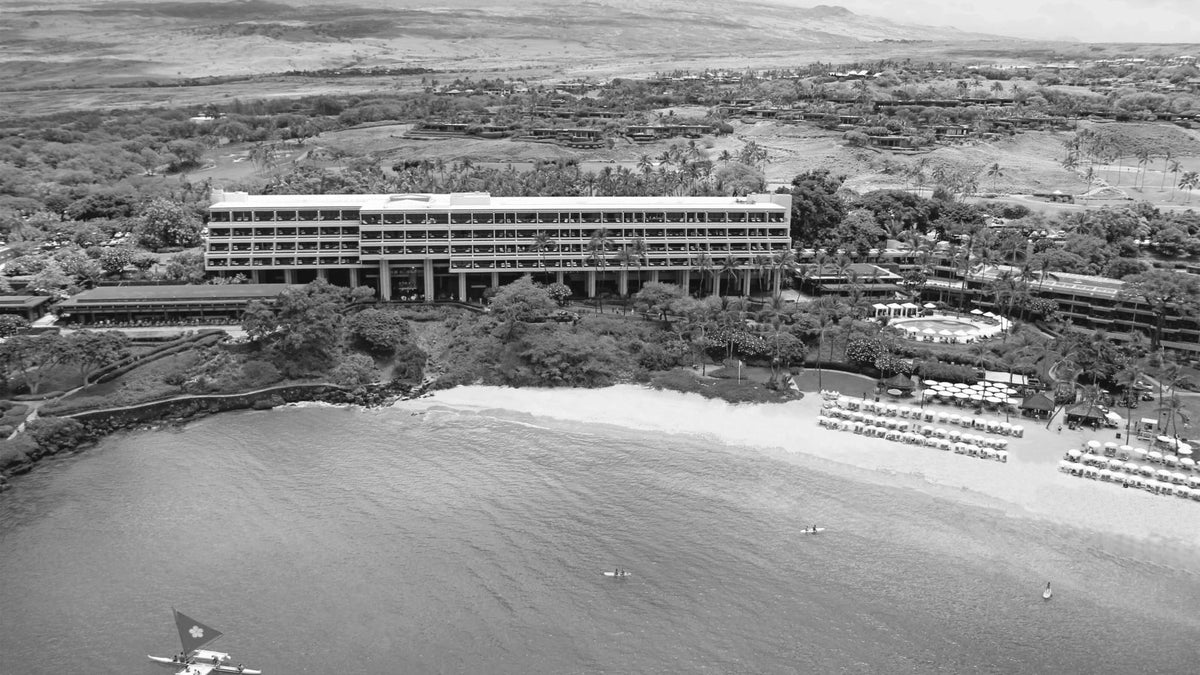
Some hotels are inseparable from a single view. At Mauna Kea Beach Hotel on Hawaiʻi Island, it is the long, pale crescent of Kaunaʻoa Bay: a shore that makes the resort’s low-slung architecture appear less imposed upon the coast than carefully set behind it. Sixty years after its opening, and following a near-$240 million renewal, the property has returned to this original proposition with unusual clarity.
The work is extensive rather than theatrical. Guest rooms, suites, the main lobby, retail spaces, pools, fitness facilities and the Spa at Mauna Kea have all been renewed, yet the more compelling achievement is the preservation of a particular spatial attitude. The hotel still understands that its greatest room is outside: the bay, the breeze, the dark lava coast and the changing line between water and sky.
A resort designed to recede
Opened in 1965 as Hawaiʻi Island’s first resort, Mauna Kea Beach Hotel was developed by Laurance S. Rockefeller at a moment when large-scale leisure travel was often expressed through conspicuous monumentality. Its lasting distinction lay in choosing another language. The architecture was arranged in measured horizontal planes, allowing gardens, open corridors and the coastline to remain visually dominant.
That decision still gives the hotel its composure. Arrival does not culminate in an oversized interior spectacle. Instead, the building makes a sequence of thresholds: driveway to planted court, shaded lobby to terrace, terrace to beach. The experience depends on calibrated release. Walls frame rather than compete with the Pacific; deep eaves and covered walkways make shade feel structural rather than ornamental.
The current restoration has been led architecturally by Honolulu practice AHL, with interiors and new guest experiences shaped around the hotel’s established relationship with landscape. AHL has described its approach in terms of filtered and framed views, treating the original architecture as something to be clarified rather than overwritten. That is a useful distinction. Too many restorations confuse renewal with replacement. Here, the strongest gesture is restraint.
The work of keeping a cultural collection alive
Mauna Kea has always carried more than a beach-resort identity. Rockefeller assembled a substantial collection of Asian, Oceanic and Pacific art for the property, placing museum-quality works within the everyday circulation of the hotel. The collection remains part of its public rhythm, with guided art tours offering a more considered way to move through the building than simply passing from room to pool.
This is not a matter of decoration. Art at Mauna Kea establishes pauses within the architecture: an object seen at the edge of a corridor, a sculpture set against vegetation, a quiet encounter before the sea reappears. In the renewal, this aspect of the hotel has gained greater significance. New spaces may improve comfort, but the collection keeps the resort connected to its founding ambition to combine hospitality, nature and cultural attention.
The same principle shapes the newer spa. Rather than closing guests into an atmosphere of generic wellness, its setting uses gardens, water and open-air sightlines to keep the coast present. The adult infinity pool and expanded fitness spaces similarly make the horizon part of the architecture. It is a resort model that rewards lingering, but does not insist on performance.
A different kind of resort ritual
The rituals at Mauna Kea are strongest when they remain specific to the site. Mornings begin with the bay almost still; later, the beach fills in gently rather than becoming a stage. At dusk, the property’s celebrated manta-ray viewing introduces a more elemental spectacle, drawing attention outward to the water instead of back towards a hotel bar or branded event.
There is a corresponding rhythm in the hotel’s public spaces. The lobby is porous and unhurried, its open edges allowing air, sound and light to pass through. A meal by the shore, a walk between the Beachfront Wing and the main building, or an art tour undertaken before the heat rises all become part of a stay shaped less by scheduling than by temperature and tide.
That sense of unforced order matters. Mauna Kea is not attempting to disguise its scale, nor to become a private house. It remains a proper resort, with golf, tennis, restaurants and 252 rooms and suites. But its best spaces preserve a rare degree of visual quiet. The buildings neither demand constant attention nor abandon guests to anonymous luxury.
What renewal should preserve
The most successful hotel renovations retain the reason a place mattered before its latest chapter. At Mauna Kea, that reason is not simply heritage, and certainly not nostalgia for mid-century resort travel. It is the intelligence of an architecture that lets environment dictate behaviour: walking slowly beneath shade, sitting outside after dark, looking through a lobby instead of at it.
For contemporary resort culture, this remains a persuasive lesson. Luxury need not be built from excess or perpetual novelty. It can reside in a long view kept clear, in materials that do not fight the climate, and in the confidence to make transition between suite, lobby, terrace and shoreline feel seamless.
That is also where a wardrobe for slower, more composed movement finds its relevance. The generous ease of ILHEMENT’s Swiss-designed pyjamas suits the hotel’s particular sequence of spaces: pieces considered for the interval between private room, shaded lobby and an early terrace breakfast, without confusing relaxation with neglect.
Mauna Kea Beach Hotel’s renewal is therefore most convincing not because it makes a famous resort feel newly fashionable, but because it protects its more difficult quality: a disciplined openness to Hawaiʻi Island’s coast. The horizon remains the principal ornament. Everything else has been asked to serve it.