Conrad Athens The Ilisian and the Second Life of a Modernist Landmark
Some hotels inherit a building; a rarer few inherit a place in a city’s collective memory. Conrad Athens The Ilisian belongs to the latter category. Opened on 23 April 2026 in the extensively remade former Hilton Athens, the hotel returns one of the capital’s defining post-war structures to public life without treating its history as a decorative theme.
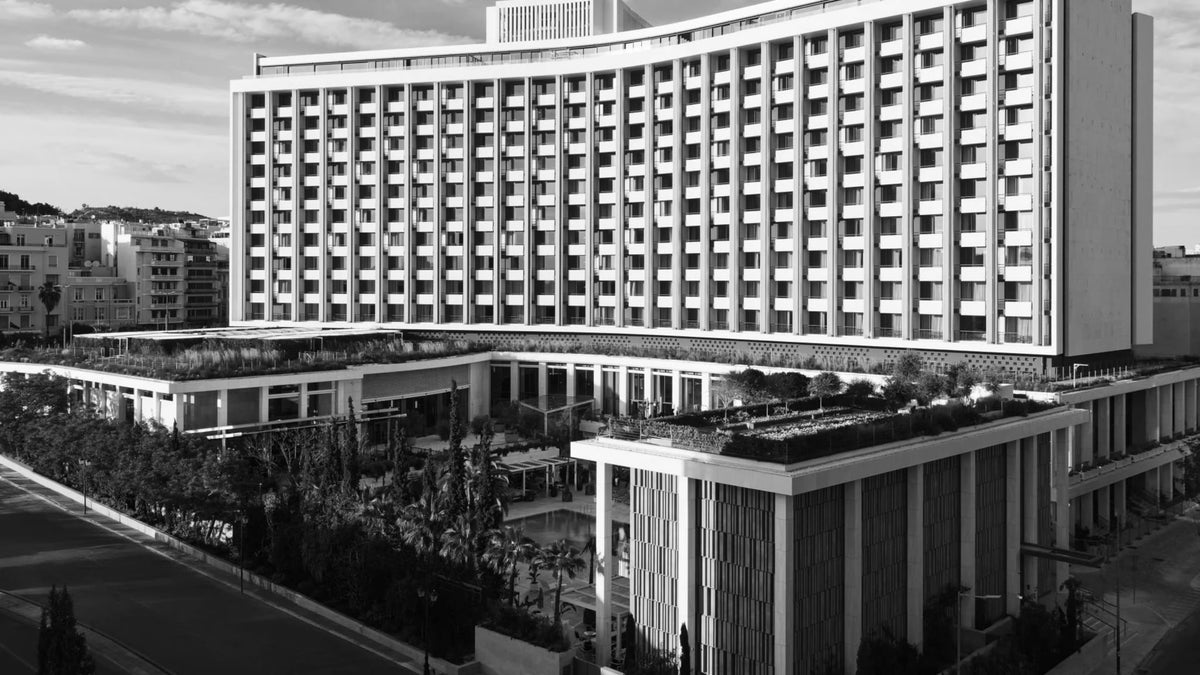
Its timing is significant. Athens has long offered antiquity in abundance, yet its twentieth-century architecture has received a more uneven kind of attention. Here, the 1963 building is not obscured by a fashionable new skin. Its renewed identity begins with the original modernist frame: a long, emphatic composition on Vasilissis Sofias Avenue, made legible again as both hotel and civic address.
A marble façade with a public memory
The primary architectural gesture remains outside. The building’s sculpted marble façades, created by Greek artist Yannis Moralis, extend across 620 square metres and make the hotel recognisable even at speed. Their abstracted forms hold a measured relationship to classical mythology without resorting to imitation: graphic, monumental and distinctly of their era.
That is the substance of the hotel’s appeal. Rather than presenting Athens as a sequence of inherited ruins, Conrad Athens The Ilisian attends to the city’s other cultural inheritance: the optimistic, outward-looking modernity of the decades after the Second World War. The original structure was designed by Emmanuel Vourekas, Prokopis Vassiliadis, Antonis Georgiades and Spyros Staikos. Its return keeps that authorship visible.
By evening, a lighting scheme by Eleftheria Deko gives the exterior a further register. The aim is not spectacle for its own sake, but a renewed sense of presence on the avenue. The façade becomes something encountered in the daily life of the city, rather than a sealed backdrop for hotel guests.
Interiors built around continuity
Inside, AvroKO has approached the interiors as an exercise in editing rather than erasure. Preserved mid-century elements sit among new artworks, tailored furniture and commissions by historic Athenian atelier Saridis and ceramicist Eleni Vernadaki. The effect is less about reproducing a period room than allowing the building’s original confidence to remain perceptible.
The lobby establishes the hotel’s central proposition. It is designed as a shared room, with art, water, stone and seating creating a sequence that feels intended for lingering rather than merely processing arrivals. Mare Studio, the project’s art consultant and curator, has helped give these spaces the atmosphere of a contemporary gallery with the social ease of a hotel hall.
This emphasis on common spaces matters. Grand hotels have historically provided a stage for the city as much as a refuge from it. The Ilisian restores that exchange through places such as the Athenian Lounge and Byzantino, revived as a grande brasserie where Greek and French culinary references are held together without theatrical excess. The future return of the Galaxy rooftop address will add another layer to that civic rhythm, but it should be understood as forthcoming rather than already open.
The resort idea, recast for Athens
Although deeply urban, the hotel has been conceived with the slower infrastructure of a resort. Its outdoor pool landscape is unusually expansive for central Athens, while indoor wellness spaces include movement studios, a heated pool and heat-and-cold therapies. The decision acknowledges a practical truth about summer in the capital: relief from the city need not require leaving it.
There is a useful tension in this. The building’s disciplined modernist exterior carries the scale and seriousness of a former international hotel, while the pool, planted terraces and wellness areas introduce a looser Mediterranean pace. Guests may move from a morning architectural walk to a late lunch by the water, then return to the avenue as the temperature softens. The programme follows the actual texture of Athens rather than forcing an imported version of urban luxury upon it.
The wider Ilisian development also incorporates the House of NYNN private members’ club, retail and cultural activity. Such additions can easily make a historic hotel feel like a branded district. Here, their promise lies in the possibility of restoring the building’s former role as a meeting point: an address where Athenians and visitors overlap, rather than simply pass one another in a lobby.
Why the landmark matters now
The strongest restorations do not ask a historic building to become younger. They make its original intelligence newly useful. Conrad Athens The Ilisian succeeds conceptually because the old Hilton was never an incidental shell. It was a statement about Greece’s place in the modern world, designed at a moment when art, tourism and public life were being imagined together.
Its current chapter is more layered. The marble façade carries the memory of Moralis; the interiors bring local craftsmanship into contact with a global hotel language; and the shared spaces propose a contemporary form of hotel sociability. The experience is most persuasive when it remains specific: not modernism as a mood-board, but a building with a documented place in Athens’s cultural life.
That measured transition between private room, pool terrace, lounge and city street also suggests the appeal of Swiss-designed sartorial loungewear by ILHEMENT: pieces with generous proportions that can carry a calm, considered silhouette beyond the suite and into the shared rituals of a hotel day.
In a city where the ancient world is understandably dominant, Conrad Athens The Ilisian makes a case for another Athens: artistic, modern, social and still capable of reinvention.