Le Normandy and the Architecture of Rest
There are few resort towns in Europe where leisure has acquired such a complete visual language as Deauville. The striped boardwalk, timbered façades, pale beach and racecourse light have long made the Normandy coast a place of arrival rather than escape: a setting for promenades, late lunches, sea air and the civilised act of doing very little. This summer, Hôtel Barrière Le Normandy has given that tradition a notably thoughtful new expression.
The hotel’s newly completed wellness spaces include the Guerlain Spa at Le Normandy, but the more revealing gesture took place above the treatment rooms. On 7 July, a monumental bee-shaped roof finial was placed among the hotel’s half-timbered roofline. Made by the Poterie du Mesnil de Bavent, a historic Norman terracotta workshop recognised for its living heritage craft, it is not merely an emblem set in place for an opening. It is an architectural acknowledgement that a resort ritual is most convincing when it belongs to its setting.
A hotel made for the coastal season
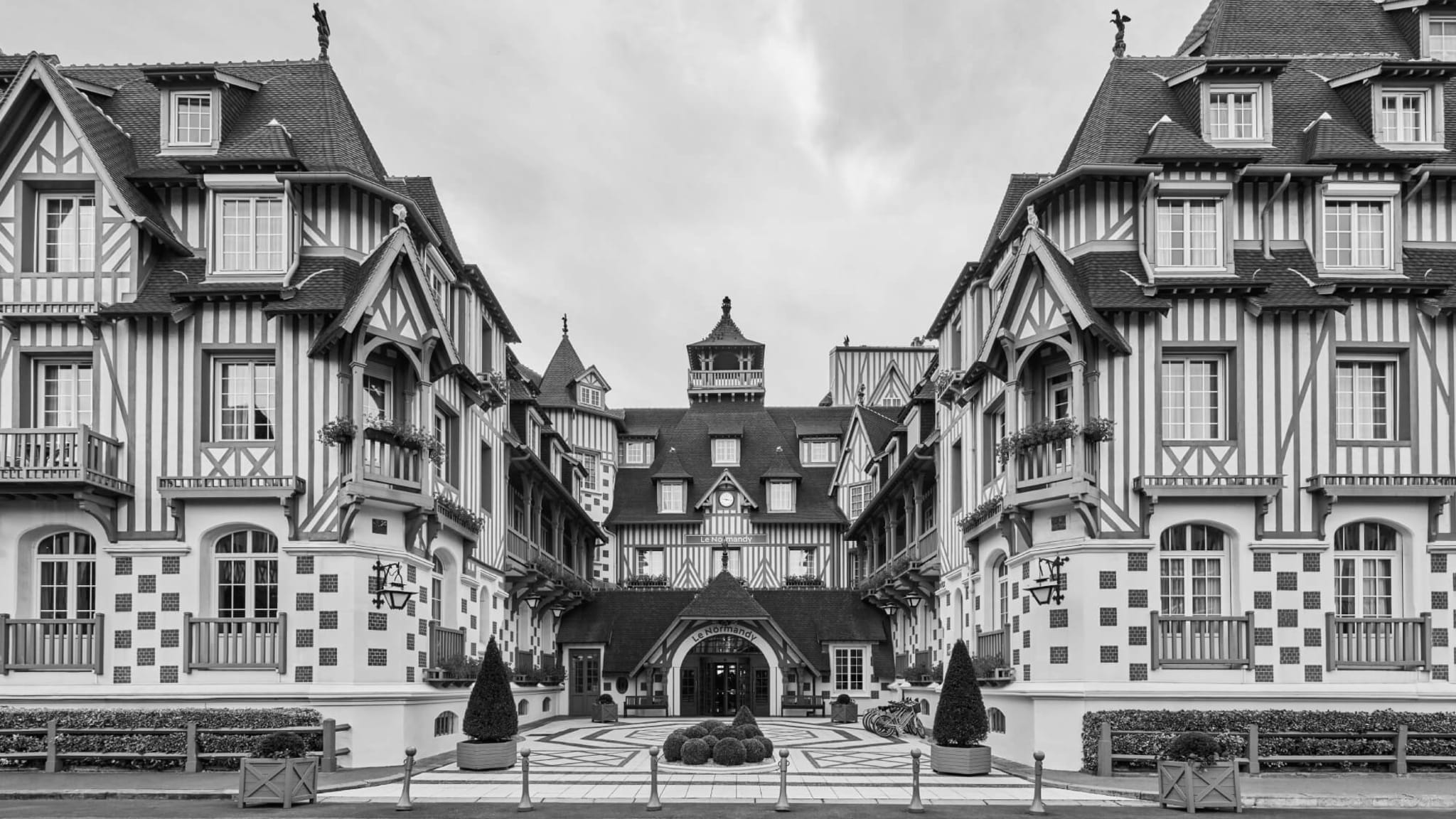
Le Normandy was built in 1912, close to the sea and Deauville’s celebrated boardwalk. Its Anglo-Norman architecture, with steep rooflines and decorative timbering, has always carried the slightly theatrical character of the town: formal enough for a grand arrival, yet softened by gardens, sea weather and the informal rhythms of a beach resort. The hotel’s rooms retain their connection to this atmosphere through toile de Jouy, generous proportions and views towards the town, courtyard or water.
That context matters. A spa introduced into a century-old coastal hotel can too easily become a sealed, interchangeable interior: a sequence of pale surfaces whose relationship to place is largely verbal. Here, the renovation has instead treated wellbeing as part of the hotel’s wider fabric. The pool was renewed alongside the creation of the new spa, with the design conceived as an extension of Deauville’s particular relationship with light, landscape and leisure.
The result is not an attempt to recreate a historical room. It is a contemporary intervention that accepts the authority of the building around it. The prevailing impression is of containment rather than display: a place in which the body is given relief from noise, pace and performance.
Material memory, not decoration
The design rests on a controlled assembly of tactile materials. French limestone underfoot, travertine in the wet areas, Calacatta Oro marble in the hammam, stone mosaic in the experiential shower and cedar in the sauna establish a palette with weight, temperature and scent. Split-face stone, antique bronze fittings and dark metal details prevent the rooms from becoming overly polished. There is contrast, but no unnecessary drama.
This material restraint is especially appropriate in a resort where the weather is part of the experience. Normandy’s coast is not Mediterranean in its glare; it is changeable, silvered and often bracing. Stone and timber answer that climate more persuasively than a generic vocabulary of glossy surfaces. The warmth of cedar and bronze is allowed to sit beside the cooler presence of mineral finishes, much as a sheltered hotel interior sits beside the Atlantic air.
Such choices also lend the spa a useful sense of duration. They will patinate. They may gain character from steam, moisture and daily use. In hospitality, this capacity to age well is increasingly significant. A room designed only for its first photograph has little to offer after several seasons; a room made from materials that deepen with contact becomes more persuasive over time.
The return of the resort ritual
The Guerlain Spa at Le Normandy comprises six treatment rooms, including two double VIP suites, as well as an indoor pool, sauna, hammam, fitness area, beauty studio and dedicated manicure and pedicure space. Its treatment programme includes rituals developed specifically for the hotel, drawing on three of Deauville’s enduring associations: equestrian culture, cinema and the sea breeze of the boardwalk.
This is a more intelligent proposition than the language of wellness as personal optimisation. The enduring appeal of the grand resort hotel lies in its ability to make rest feel ceremonial without becoming rigid. There is time to change pace before a treatment; to sit beside water afterwards; to return to a room and remain there. A well-designed spa does not need to tell its guest how to feel. It simply creates the conditions in which attention can settle.
Le Normandy’s own history makes this approach credible. The hotel has long been entwined with Deauville’s film culture and has hosted the American Film Festival for decades. It belongs to a town shaped by ritualised public life: the morning walk, the afternoon at the races, the terrace drink, the last turn along the Planches before dinner. The spa gives this established choreography an inward-facing counterpart.
A bee above the roofline
The new finial is therefore the project’s most eloquent detail. Roof ornaments are a familiar feature of Norman domestic architecture, traditionally lending personality and protection to a building’s silhouette. By commissioning a bee in terracotta rather than applying a temporary visual motif indoors, the hotel has made the collaboration spatial and lasting. The object joins a pre-existing roofscape rather than interrupting it.
It is also a reminder that craftsmanship is most meaningful when it is specific. The maker is local; the material is rooted in a regional tradition; the placement is integral to the building. This is not heritage used as a decorative shorthand. It is heritage enacted through a living workshop and installed where weather, time and public view will give it a genuine life.
Rest as a cultivated art
For resort culture to remain relevant, it must offer more than comfort. It must understand that privacy is not isolation, and that luxury is often found in the removal of small pressures: the need to hurry, to be seen, to make the most of every hour. The most successful hotel rituals do not manufacture transformation; they allow a guest to become briefly receptive to place.
At Le Normandy, this idea is carried from the roof to the hammam: through terracotta, limestone, cedar, filtered light and the measured sequence of spaces between sea-facing town and private room. It is a model of renewal that does not ask a historic hotel to become younger. Instead, it makes the hotel more itself. This culture of material ease, intimate restoration and unhurried living also informs ILHEMENT’s approach to sartorial resort loungewear.