Eréma and Milos’s Architecture of Attention
On Milos, the landscape has little interest in decoration. Its cliffs, pale earth and volcanic outcrops already possess a severe, shifting theatre; any hotel placed among them needs to know when to recede. Eréma, the 41-suite retreat newly opened at Cape Chalaka on the island’s south-eastern coast, begins with that understanding. Rather than offering a familiar whitewashed fantasy of the Cyclades, it works with mass, shadow and mineral colour to make the landscape feel closer.
The name means stillness in Greek, and the idea is not treated as a slogan. At Eréma, stillness is spatial: a measured sequence of enclosed rooms, shaded thresholds, terraces and long views towards the Aegean. In a season when much of the island economy is organised around movement, spectacle and the next beach, the hotel proposes a more disciplined pleasure: staying put long enough for light, air and texture to register.
A Hotel Drawn from the Ground
Eréma was designed by Aristides Dallas Architects and Micromega Architecture & Strategies, with interiors by ID Laboratorium. The architects have avoided pastiche. There are no theatrical domes or postcard-blue shutters competing for attention. Instead, the buildings are composed as low, monolithic volumes, their softened edges and sculpted openings recalling the geological formations of Milos without attempting to mimic them.
This matters because Milos has a visual language of its own. The island’s volcanic history is legible in its terrain: ash-coloured slopes, chalky stone, rust-red earth and improbable mineral seams. Eréma translates that vocabulary into architecture through stone walls, pale rendered surfaces, sheltered courtyards and deep apertures that frame rather than flatten the view. Its forms are contemporary, yet their restraint makes them feel less like an object inserted into the coast than a settlement gradually revealed by walking through it.
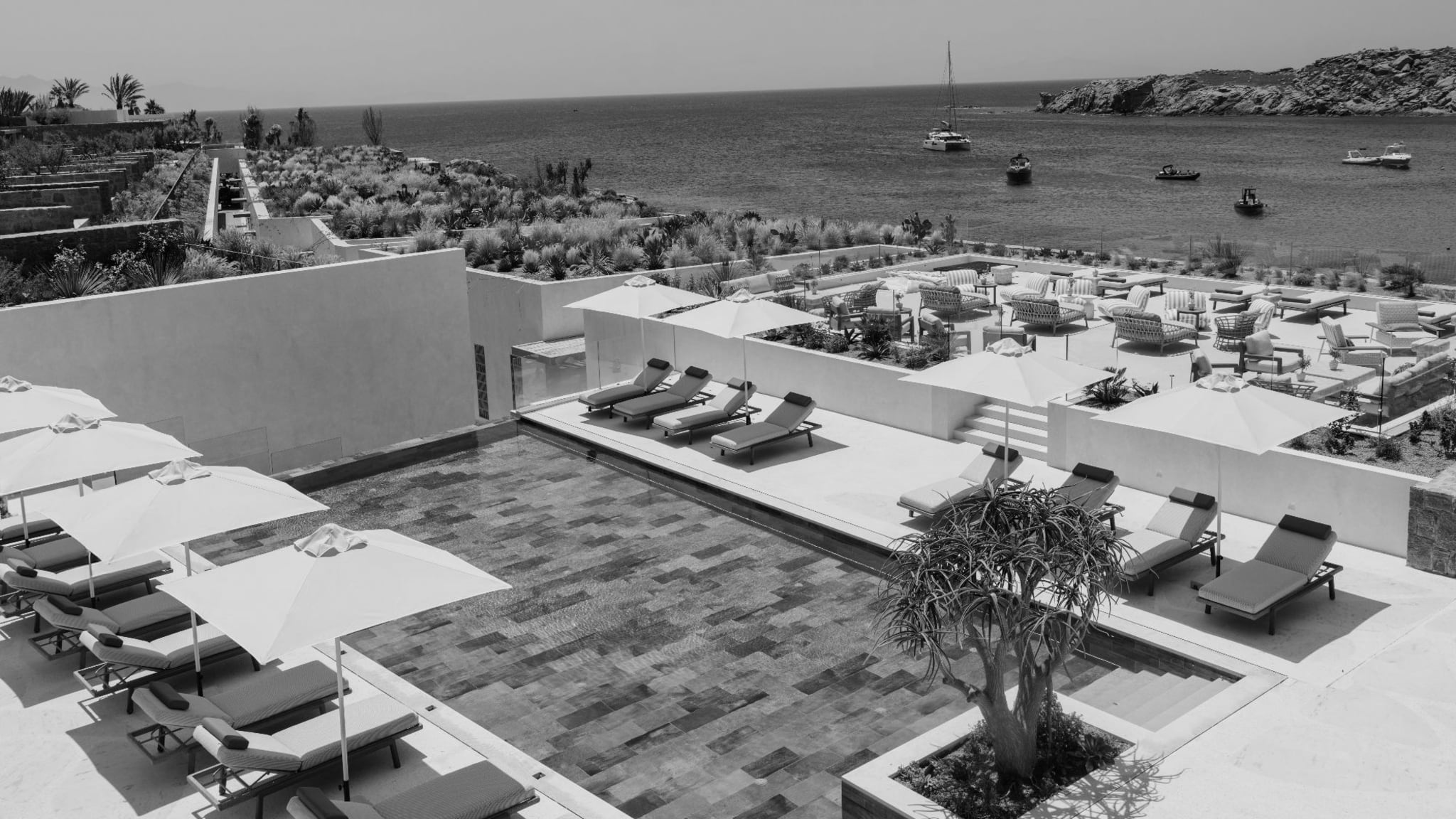
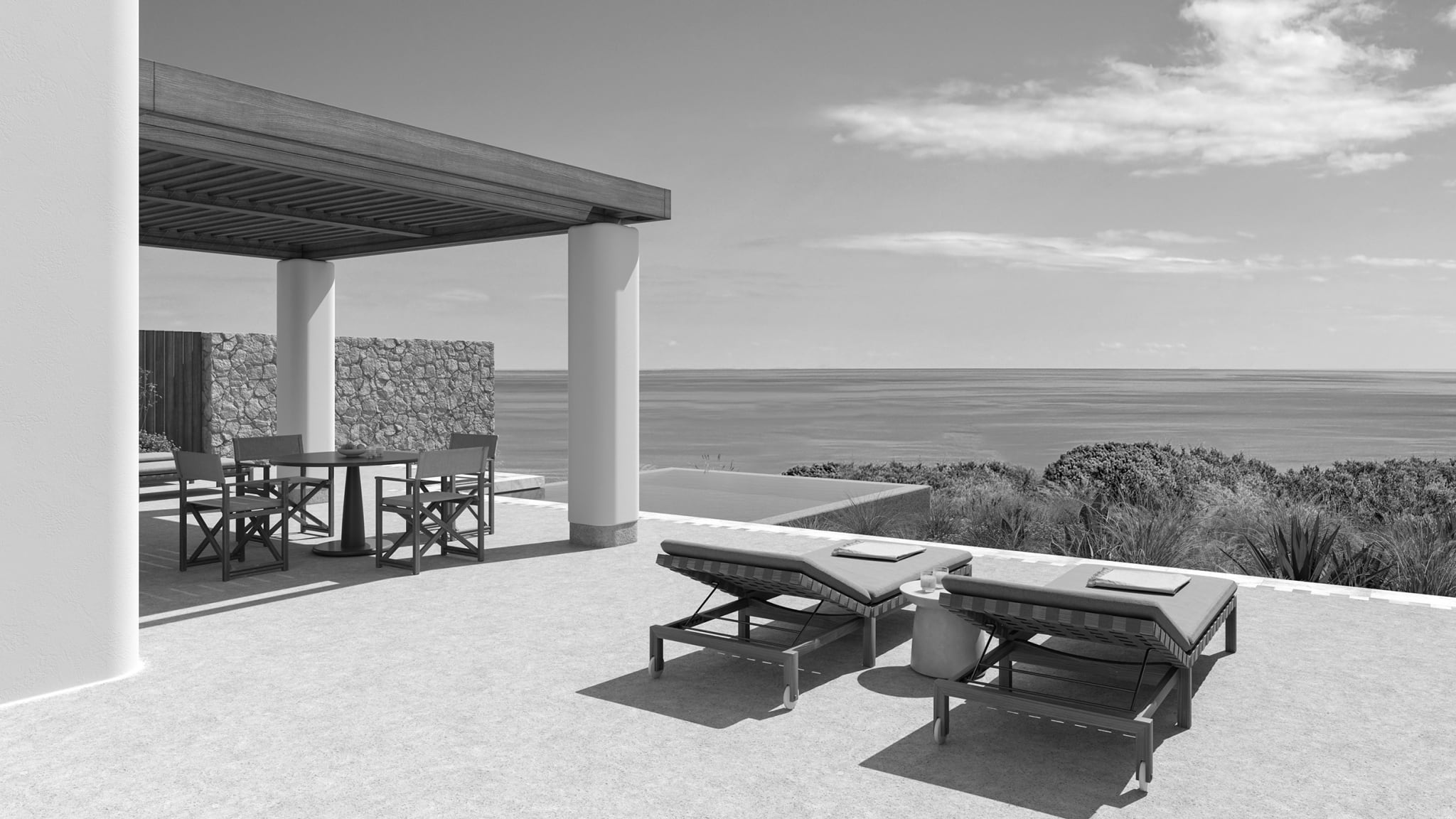
The hotel occupies a 19-stremma site near Provatas, looking across the sea. Each suite has a private pool and panoramic terrace, but the project’s intelligence lies in its refusal to make privacy synonymous with isolation. The architecture continually negotiates between retreat and exposure. A shaded room gives way to an exterior sitting area; a stone wall opens to the horizon; the enclosed calm of an interior is sharpened by a sudden band of blue.
Mineral Interiors, Not Mediterranean Theatre
Inside, ID Laboratorium has developed a palette informed by the materials associated with the island: perlite, quartz, bentonite, kaolin and sulphur. The names may sound geological, but the result is tactile rather than didactic. Whites are warm rather than brilliant, greys are softened, and earth tones appear in plaster, stone, woven fibres and timber. The rooms do not perform rusticity. They are quiet, generously proportioned spaces in which texture carries more weight than ornament.
That approach is especially effective in the shared areas. Rather than creating a lobby as a social stage, Eréma gives communal spaces a residential ease. Seating is low and composed, openings are carefully placed, and the materials keep the eye close to the surface before returning it to the landscape. The experience is of a place calibrated for decompression, not display.
The wellness spaces extend this logic. A linear pool forms the centre of the spa complex, oriented towards the sea and conceived as a threshold between treatment, exercise and rest. The arrangement is telling: the water is not merely an amenity to be photographed, but an architectural device that slows circulation and gathers people after a yoga session or treatment. It gives the idea of wellness a social dimension without sacrificing quiet.
Living with the Horizon
The strongest gesture at Eréma is its treatment of the horizon. Many Aegean hotels promise a view; fewer understand how to choreograph one. Here, sightlines are repeatedly interrupted, filtered and released. Curtains move in sea air. Pergolas temper the hard noon light. Stone parapets create a sense of enclosure before the water reappears. The landscape is never simply a backdrop. It becomes the hotel’s changing interior wall.
This is also where the property finds a more credible form of luxury. The private pools and expansive terraces are undoubtedly generous, but the deeper luxury is attentional. Eréma makes a case for a day with fewer appointments: a swim before breakfast, a long interval under shade, a late lunch facing the water, an evening in which the colour of the sea is enough to occupy the room.
Its two restaurants build on that principle of orientation. Akiton, named after an ancient name for Milos, places dining between land, sky and sea. The setting matters as much as the menu: terraces, open-air tables and low walls make eating feel connected to the site rather than detached from it. The island’s food culture is naturally close at hand, but the architecture prevents the experience from becoming merely scenic.
A Different Cycladic Tempo
Eréma arrives at a moment when the Cyclades are being asked to accommodate competing desires. There is the appetite for access, energy and constant novelty; there is also a growing wish for places that make room for silence, landscape and a less extractive form of enjoyment. Milos has long offered an alternative to the louder rhythms of neighbouring islands, though its own popularity is rising quickly. A hotel here must therefore offer more than a polished version of escape.
Eréma’s contribution is to make slowness concrete. It does so through proportions, materials and the careful management of exposure. Its architecture never entirely disappears, nor should it: the project is confidently authored. But it remains subordinate to the island’s weather, geology and horizon. That is a difficult balance, and one that gives the hotel its character.
For travellers who understand resort life as an opportunity to recalibrate rather than accumulate, this is the appeal. Rest becomes less about withdrawal from the world than a closer attention to it: a cool floor under bare feet, a curtain lifting in the afternoon wind, the gradual turn of light across a stone wall. This philosophy also informs ILHEMENT’s approach to sartorial resort loungewear: comfort considered not as an absence of form, but as a way of moving through a place with greater ease.
Eréma is not trying to outshine Milos. Its better instinct is to let the island remain formidable, then provide a composed frame from which to look again.