La Darbia Chianti and the Discipline of Staying Put
There is a particular kind of Tuscan luxury that has little to do with arrival. It begins, rather, with the decision not to leave too quickly. La Darbia Chianti, newly opened in the hills above Panzano, makes a persuasive case for this slower register of resort life. Within an 11th-century hamlet of stone buildings, the new retreat favours continuity over theatre: the measured repair of old walls, the practical beauty of local materials, and days structured by light, appetite and the changing view.
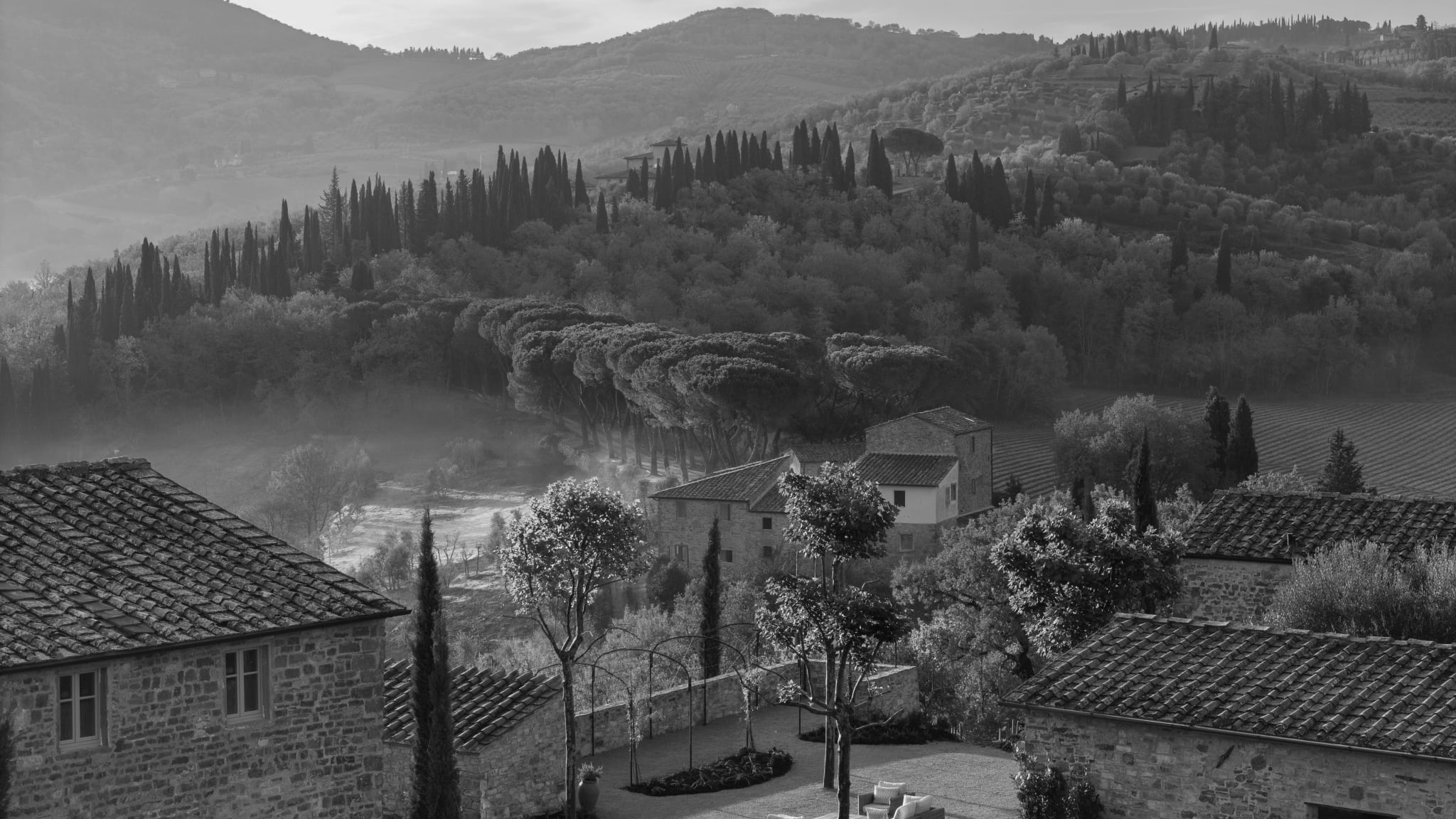
Its setting is familiar in the most reassuring sense. Vineyards and olive groves fold across the Chianti hills; cypress trees punctuate the slopes; Panzano sits nearby, sufficiently close for an aperitivo or a morning errand, but not so close that the estate loses its sense of remove. What distinguishes La Darbia is not a claim to reveal an undiscovered Tuscany. It is the more difficult achievement of making a much-imagined landscape feel private, inhabitable and newly attentive.
An old hamlet, carefully re-inhabited
La Darbia Chianti occupies a 15-hectare hillside estate, where a group of historic farm buildings has been restored as 17 suites. The project was led by the Italian architect brothers Gian Carlo and Matteo Primatesta, who have treated the original fabric as a guide rather than an inconvenience. The result is not a country house dressed in nostalgic shorthand, nor a sharpened contemporary insertion seeking to announce itself against the hills. It is an ensemble whose appeal lies in proportion, texture and an evident respect for what was already there.
The architecture is organised across two distinct areas of the estate. At the lower level, rooms gather around a courtyard and the old tower house; above, larger suites open towards gardens and the hilltop. This arrangement preserves a sense of village life rather than reducing the site to a single hotel block. Paths, thresholds and outdoor spaces matter here. One moves through the property as through a small settlement, with the welcome complication of distance between one’s room, the pool, the restaurant terrace and the next point of repose.
That spatial rhythm is central to the property’s character. It offers privacy not through isolation alone, but through the modest intervals that allow a guest to feel unobserved: a turn behind a stone wall, a chair beneath a tree, a window framing only fields and sky. In contemporary hospitality, where every communal room can seem designed for display, such moments are increasingly valuable.
Craft as atmosphere
The restoration relies on materials deeply associated with central Italy: pietra serena, terracotta, travertine and timber. Yet their presence is not merely decorative. Stone gives the rooms their weight and coolness; lime-toned plaster softens the old masonry; timber beams retain the rhythm of the original structures. Bespoke joinery and local craft bring precision without making the interiors feel over-composed.
This is an important distinction. The most convincing restorations do not make history look pristine. They allow age, repair and use to remain legible. At La Darbia, fireplaces are formed from weathered stone, while bathrooms introduce clay tubs and sculptural stone elements that feel contemporary without competing with the architecture. Large windows, meanwhile, bring the landscape into close relation with the rooms. They do not turn the countryside into scenery; they make weather and season part of the interior experience.
Such restraint is especially suited to Chianti. The region’s visual language is already strong: tiled roofs, pale stone, vineyard lines, dark cypress and dusty lanes. Adding too much would only dilute it. La Darbia’s contribution is to refine the conditions in which guests notice these things anew: an unhurried breakfast, a shaded afternoon, the changing colour of the hills before dinner.
The resort ritual of the hillside
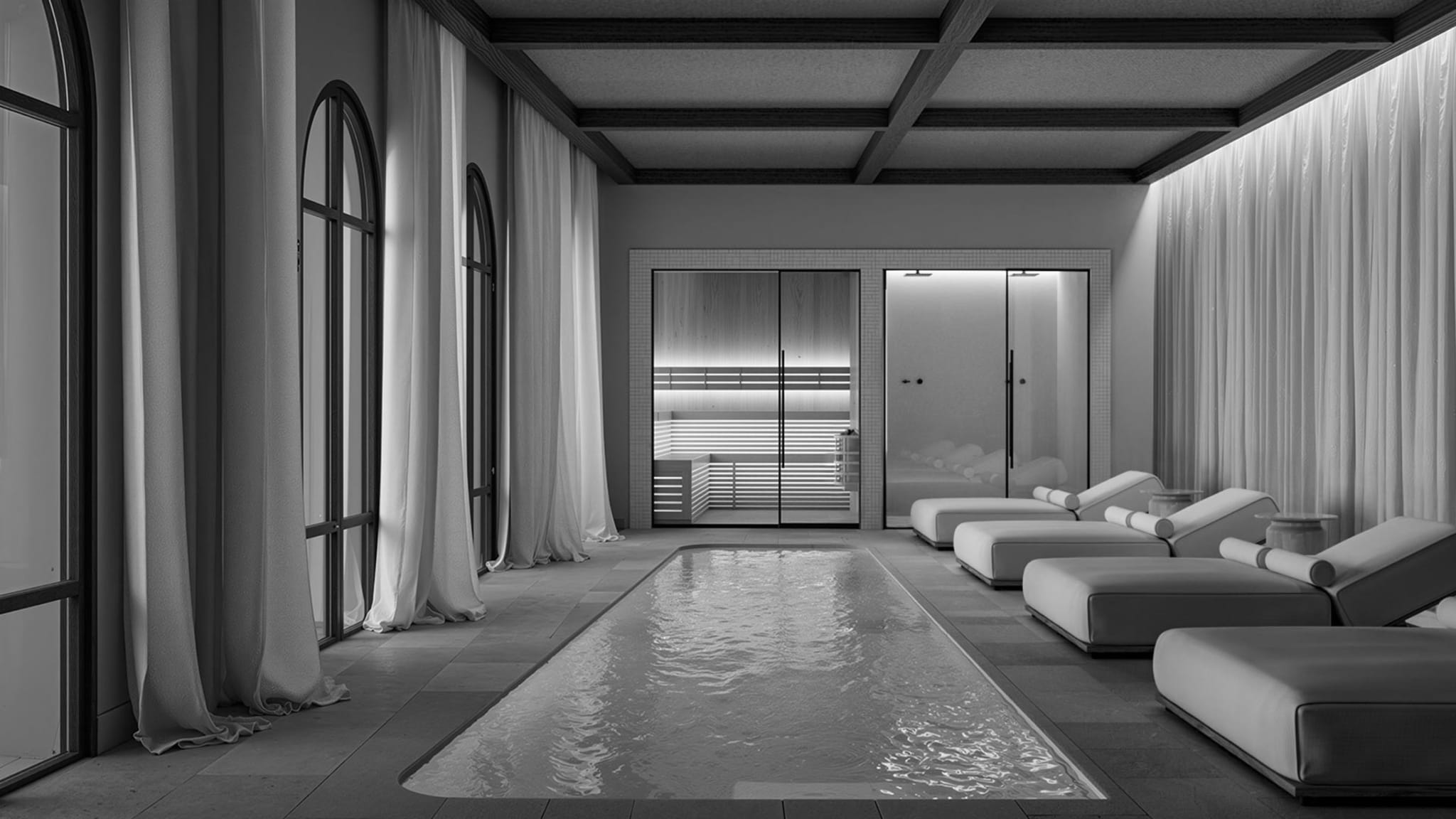
Two pools are set across the estate, each serving a different cadence of the day. Their purpose is not spectacle, but pause. Swimming here belongs to the Tuscan afternoon: the interval after a late lunch, before the return of appetite, when heat settles over the terraces and the most sensible ambition is to do very little. In this sense, the hotel understands the difference between wellness as programming and restoration as permission.
The restaurant, positioned towards the lavender fields and the hills around Panzano, develops the same idea through seasonal Tuscan produce. It is a setting that encourages lingering rather than itinerary-building. The neighbouring countryside has ample diversions: the Romanesque Pieve di San Leolino, the medieval village of Montefioralle, the vineyards around Lamole and the small, long-established wine estates of the area. But La Darbia’s deeper proposition is that cultural richness need not always be consumed at speed.
To stay in one place, long enough for its small rituals to become one’s own, is an undervalued pleasure. There is the walk to coffee before the heat rises; the return from a village with fruit or a bottle of wine; the instinct to change into something softer before the evening begins. The finest resorts understand that their real offering is not activity, but the graceful removal of pressure to be active.
A different measure of abundance
La Darbia Chianti arrives at a moment when many new rural hotels feel compelled to provide an all-encompassing interpretation of place. The more persuasive gesture here is one of editing. The estate provides the essential conditions—beautiful rooms, cultivated grounds, good food, water, shade and a relationship to the surrounding hills—then leaves space for the guest’s own habits to emerge.
This is where the property’s restoration becomes more than an architectural story. It proposes a manner of living in landscape: composed, tactile and deliberately unhurried. The suite becomes a place for reading in the late afternoon, not merely sleeping between excursions. The terrace becomes an extension of the day rather than a backdrop for it. Even the act of dressing takes on a quieter purpose, favouring garments that are easy in private and sufficiently considered for dinner beneath the open sky.
This philosophy also informs ILHEMENT’s approach to sartorial resort loungewear: clothes made for the intervals that define a stay as much as the occasions that punctuate it. At La Darbia, the most memorable luxury is not an event at all. It is the rare assurance that there is nowhere else one needs to be.