Article: Île de Bendor and the Art of a Mediterranean Return
Île de Bendor and the Art of a Mediterranean Return
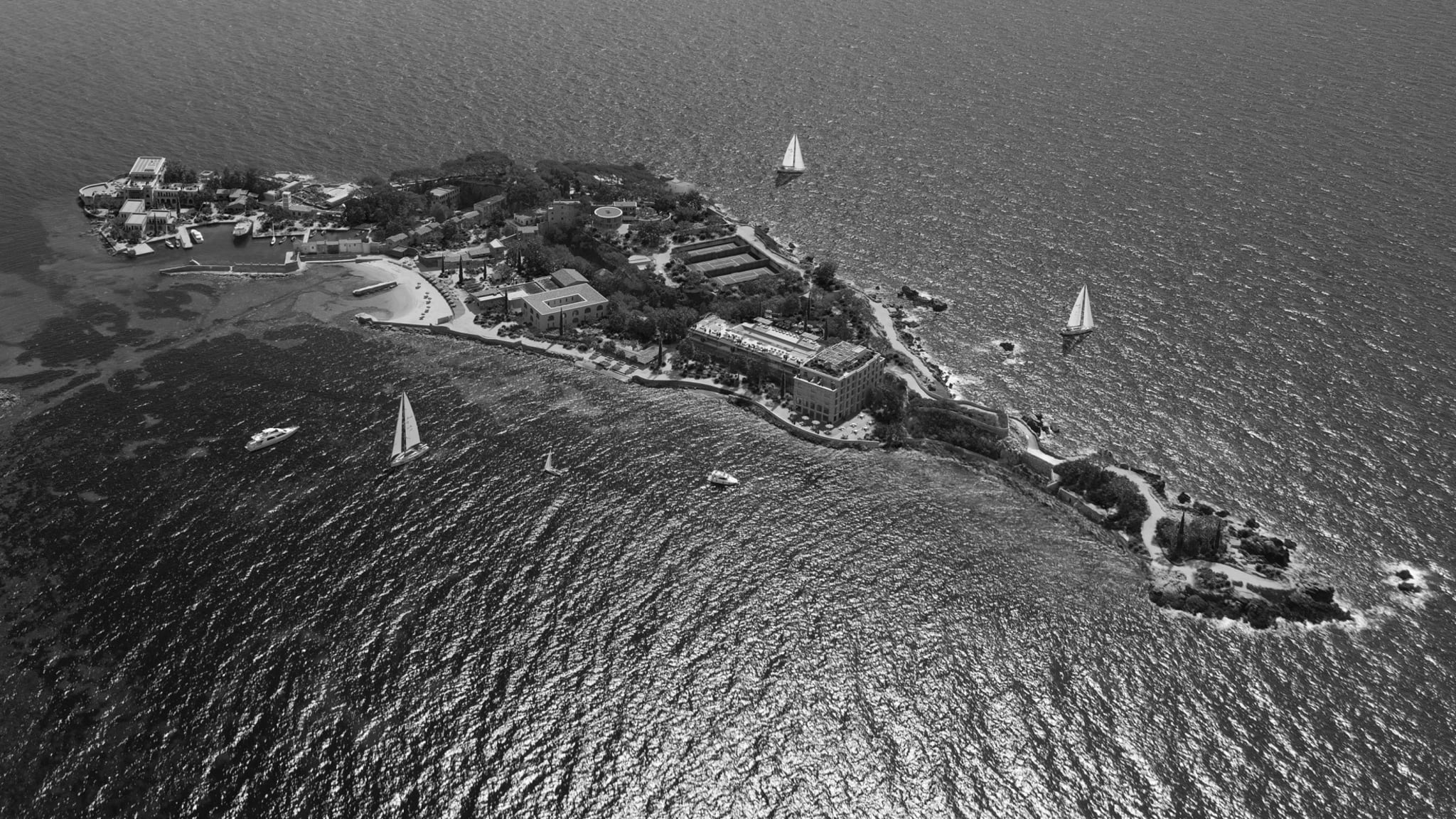
There are few places on the Mediterranean coast where arrival still carries the force of a small ceremony. Île de Bendor, the seven-hectare island just off Bandol in Provence, is one of them. The crossing takes only minutes, yet the passage from mainland quay to island harbour establishes a useful distance: not isolation, precisely, but a loosening of the ordinary rhythm.
Reopened to the public on 1 May 2026 after five years of work, Bendor returns at a moment when established resort culture is being reconsidered. Its renewal is not simply a hotel project, nor a decorative exercise in Riviera nostalgia. It is an attempt to recover an island conceived as a complete, sociable world: a place of swimming, walking, eating, making and lingering, held together by the scale of its landscape.
A private vision with a public character
Bendor was acquired in 1950 by Paul Ricard, who shaped the rocky island opposite Bandol into a personal expression of Mediterranean life. Hotels, restaurants, an art gallery, a theatre, a diving centre, gardens and workshops followed. Through the 1960s and 1970s, it became a gathering place with an unusually open spirit: its pleasures were cultivated, but never intended to be solemn.
That history matters because the island’s strongest quality has always been its mixture of intimacy and common life. A guest might retreat to the shade of a room or a quiet cove, then return without effort to a harbour café, a game of pétanque or an evening table. In the best resorts, privacy is not a sealed-off privilege. It is the confidence that one may choose one’s level of participation at any given hour.
The recent Île de Bendor restoration has retained this principle. Rather than concentrating the stay in a single monumental structure, the renewed hospitality is dispersed across three distinct settings: Delos, Soukana and the small Madrague houses near the harbour. Together they comprise 93 rooms and suites, but the island’s essential accommodation remains the terrain itself: the paths, terraces, pine cover, harbour edge and sea-facing ledges that give each day its own sequence.
Restoration as a matter of proportion
Hardel Le Bihan Architectes led the extensive rehabilitation with landscape architects Niez Studio. Completed in April 2026, the scheme involved the restoration and rebuilding of existing structures while addressing a wider question: how could an intensely developed leisure island feel less built upon?
The answer lies in proportion rather than spectacle. New interventions do not rely on a single visual gesture. Stone walls, lime-toned surfaces, tiled roofs, planted thresholds and arched openings establish a vocabulary that sits comfortably with the Provençal coast, while allowing the island’s slopes and shoreline to remain legible. The architecture is strongest where it accepts that the sea, rather than the building, is the principal façade.
Landscape has been given equal importance. Areas of hard surface have been reduced and replanted with Mediterranean species including Aleppo pine, tamarisk, fig, rosemary and cistus. Such decisions are easily framed as environmental gestures, but their emotional value is equally significant. Fragrance, shade and the irregularity of a planted path are what make a resort feel inhabited rather than merely serviced. They turn circulation into a form of repose.
At Soukana, the wellness spaces are conceived in a more grounded register, with pale Gard stone and a measured reference to Roman bathing culture. Delos, by contrast, draws on the easy theatricality of the mid-century Riviera: woven textures, striped cotton, vintage furnishings and broad openings towards the water. The contrast avoids a uniform hospitality language. One part of the island is for restoration of the body; another for the conviviality of an unhurried afternoon.
The ritual of the small crossing
Contemporary hospitality often treats arrival as a problem to be made frictionless. Bendor suggests that a modest degree of ceremony can be more valuable. The boat crossing from Bandol is not an inconvenience before the stay begins; it is the first act of the stay. It removes the car, alters the horizon and makes one aware of weather, salt and distance.
This is a lesson that grand hotels once understood instinctively. A station platform, a lakeside landing or a mountain funicular could prepare a guest for a change of tempo. On Bendor, the harbour does this work. The point is not exclusivity for its own sake, but transition. One arrives with fewer decisions to make and a more precise awareness of place.
From there, the rituals are deliberately simple: a morning swim before heat gathers on the stone; coffee at the quay; a walk around the exposed southern edge; lunch extended under an awning; the cool interior of a room in the middle of the day; a drink as the water darkens. The island’s revival is most persuasive when it protects these intervals from excessive programming.
Conviviality without performance
Bendor’s original identity was inseparable from art, food and informal sociability, and these strands have been reinstated through restaurants, workshops and exhibition spaces. The former Vincent Scotto theatre now serves as a gallery, while artist residencies and maker-led gatherings continue the island’s long association with creative practice.
There is a useful distinction here. Resort culture can easily confuse activity with vitality. A fuller calendar does not necessarily make a place more alive. Bendor’s potential lies in allowing culture to occur at the scale of the island: an exhibition visited between a swim and supper; a ceramic workshop that rewards attention without demanding an entire day; a table that becomes livelier because the same faces have crossed paths since morning.
Such settings also invite a more considered way of dressing. Resort clothing need not announce the occasion; it should be equal to the changeable demands of sun, shade, salt air and a late meal by the harbour. This philosophy also informs ILHEMENT’s approach to sartorial resort loungewear: pieces intended for the gradual transitions of the day, rather than a succession of staged moments.
An island with memory
The success of the renewed Bendor will depend on whether it can remain more than a beautifully finished retreat. Its most distinctive inheritance is not a particular room, restaurant or view, but the idea that a resort can belong to its surroundings and still possess a world of its own.
By restoring the island as a walkable, planted and socially porous place, the project offers a quieter proposition for the contemporary Riviera. It asks guests to value the recurring pleasures that have always made Mediterranean summers memorable: the first swim, the long lunch, the cooling stone floor, the evening crossing of a small square, and the rare sensation that there is nowhere else one needs to be.