Hotel Sacher Wien and the Discipline of Living Tradition
Grand hotels are often described as repositories of history. Hotel Sacher Wien suggests a more demanding proposition: history must be actively maintained, edited and occasionally unsettled if it is to remain alive. In its 150th year, the family-run Vienna institution has gained renewed recognition with a Three MICHELIN Key distinction, while two monumental sculptures by Austrian artist Erwin Wurm stand outside its entrance. The contrast is deliberate. Behind them lies a hotel built on continuity; before them, a contemporary gesture asks what such continuity can mean now.
Opened by Eduard Sacher in 1876, opposite the Vienna State Opera, the hotel is inseparable from the city’s cultural habits. It is a place shaped not only by rooms and service, but by the accumulated rituals around them: an arrival beneath the canopy, a pause in the Blue Bar, a table set for cake and coffee, a return from the opera through a lobby whose atmosphere does not depend on novelty.
A hotel held in the family
The useful distinction at Sacher is between preservation and nostalgia. The former requires decisions; the latter merely repeats a picture of the past. Alexandra Winkler, who leads the family business with her brother Georg Gürtler, has described the hotel as a long-term responsibility rather than an asset to be periodically reinvented. That perspective is visible in the building’s gradual evolution.
The hotel occupies six connected houses, a complexity that makes any intervention less like a wholesale redesign than a process of architectural listening. During renovations, historic details have continued to emerge: an 1881 stucco ceiling, for example, discovered during works and retained. The major restructuring of the early 2000s enlarged the reception area and added upper floors, while subsequent renovations have proceeded room by room and floor by floor. This is not restoration as a single theatrical event. It is maintenance as culture.
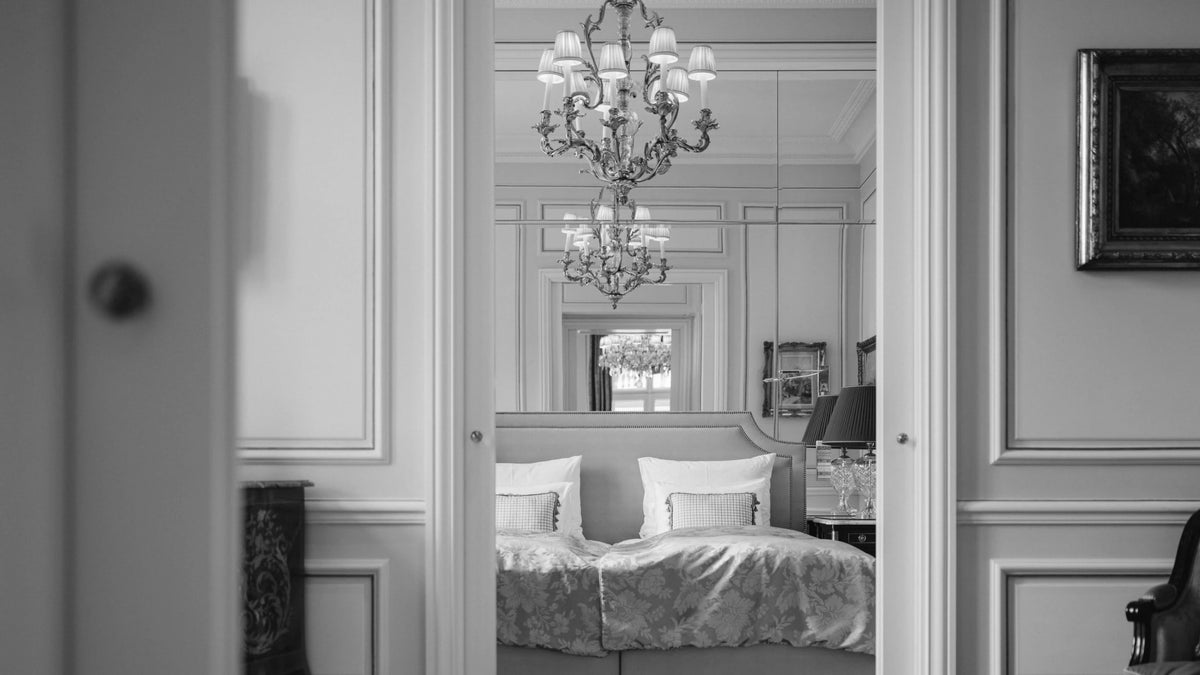
The resulting atmosphere has a particular density. Marble, dark timber, portraits, chandeliers and deeply upholstered seating create the expected grammar of a Viennese grand hotel, but the spaces avoid becoming a museum set because they remain operational. Doors open and close. Guests arrive after performances. The bar gathers a different tempo after dark. The furnishings are not simply displayed; they are used, repaired and returned to their place.
The public room as ritual
Sacher’s strongest spaces are not necessarily its most photographed. The Blue Bar, with its dark-blue brocade walls, crystal chandelier, gilt-framed portraiture and low seating, demonstrates how a room can cultivate privacy without becoming austere. Its scale is domestic rather than palatial. The effect is less one of spectacle than of enclosure: a public interior designed to make conversation feel protected.
That instinct also explains the hotel’s continued relevance in a city where coffee houses, concert halls and apartment salons have long blurred the lines between public sociability and private life. Hotel Sacher Wien does not imitate the home; it makes the hotel behave with some of a home’s discretion. The point is not informality. It is a carefully observed ease, achieved through proportion, lighting and the sense that one may stay a little longer than planned.
The culinary legacy, inevitably, is part of the architecture of the stay. Franz Sacher created the cake that bears his name in 1832, decades before the hotel opened. At Sacher, however, the famous torte is more than a souvenir or a dessert. It is a repeated civic ritual, served in rooms that frame the act with ceremony but not stiffness. Such small, legible customs are important to a grand hotel. They give a guest something more durable than an amenity: a way to participate in the life of a place.
Contemporary art at the threshold
The 150th anniversary has made that relationship between inheritance and the present unusually visible. Erwin Wurm’s two sculptures, titled Step Big and Dancer, were installed outside the hotel entrance in March 2026. Resembling oversized bags on exceptionally long legs, they introduce an improbable, animated silhouette against the historic façade.
The installation is not an attempt to make the hotel seem younger. Its value lies in the opposite move. By placing an irreverent contemporary artwork at a highly ceremonial threshold, Sacher acknowledges that tradition becomes brittle when it cannot tolerate friction. The sculptures do not replace the building’s identity; they sharpen it. Guests approach a familiar entrance through an image that is playful, slightly strange and distinctly of its own moment.
This approach has a wider relevance for heritage hospitality. The most convincing historic hotels are neither sealed off from contemporary culture nor remade in its image. They create a measured dialogue between the two. At Sacher, that dialogue appears in the choice to retain found architectural details, to refresh rooms without abandoning their character, and to let a modern artist interrupt the façade for one anniversary year.
Carrying the stay beyond Vienna
There is a sartorial parallel in the hotel’s refusal to reduce comfort to casualness. The most enduring forms of ease are structured: a well-lit room, a chair with the right depth, a service ritual that feels intuitive because it has been considered. That is close to the appeal of pleated pyjamas by ILHEMENT: Swiss-designed unisex pieces whose generous proportions can move with composure from suite to lobby, terrace and ordinary life beyond the stay.
At 150, Hotel Sacher Wien remains persuasive because it understands that grandeur is not secured by ornament alone. It depends on a daily practice of attention: to materials, rituals, people and the changing cultural life outside the door. Its achievement is not to have escaped time, but to have learned how to receive it.