Fouquet’s Mykonos and the New Discipline of Exposure
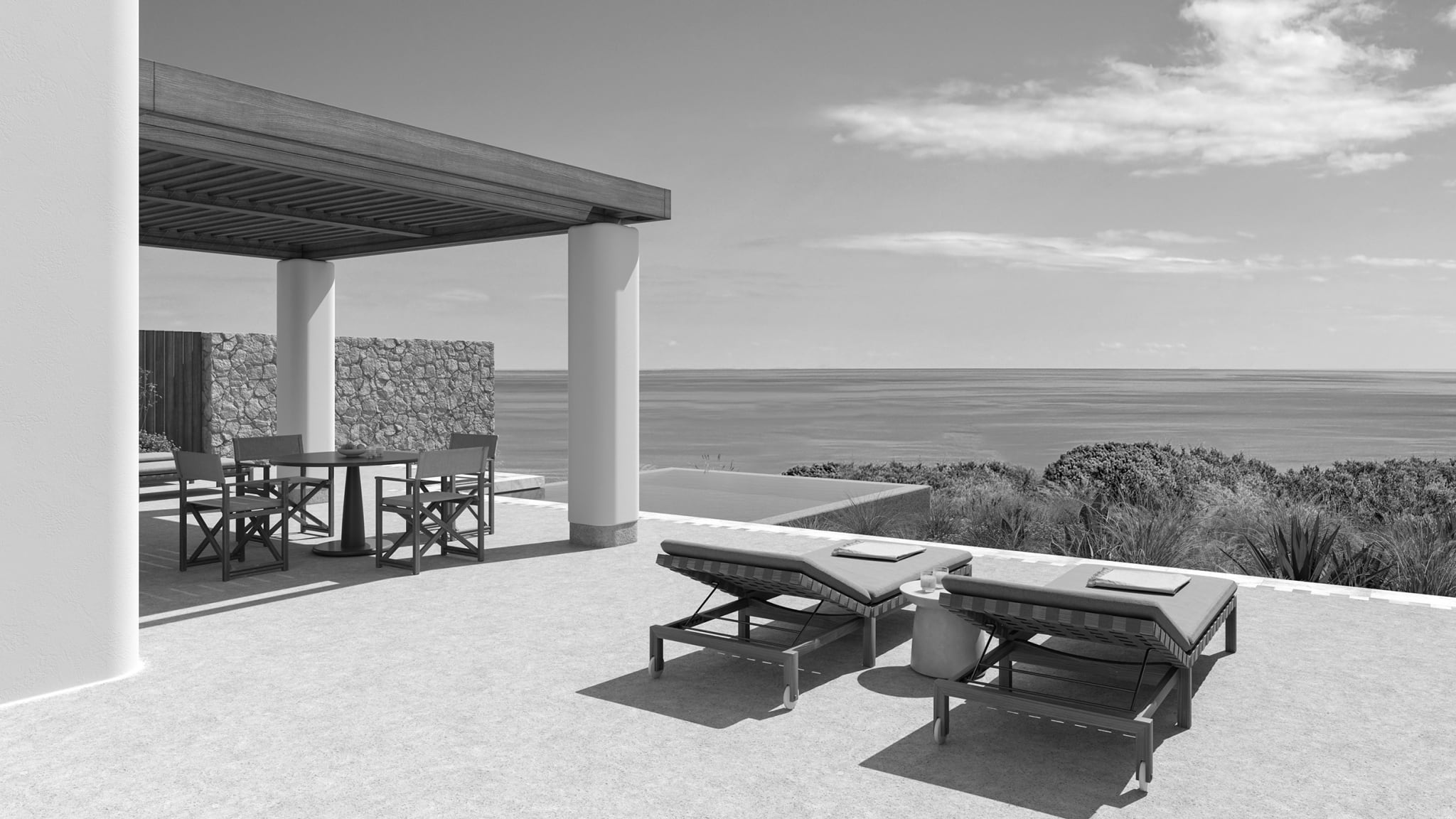
Mykonos has rarely lacked places to be seen. Its harder question has always been how to withdraw without leaving the island’s particular charge behind. Fouquet’s Mykonos, which opened on Paraga Beach on 27 June 2026, addresses that tension through an architecture of calibrated exposure: sea views are generous, but never entirely unframed; the social life is present, but held within a sequence of walls, terraces and planted thresholds.
The new hotel is the fifth Fouquet’s address, following Paris, New York, Courchevel and Saint-Barthélemy. Yet its interest lies less in exporting a familiar French signature than in testing what a recognisable hospitality name can become on the Cycladic coast. Here, the island is not treated as a blank white backdrop. Stone, shadow, water and the roughness of the shoreline are allowed to set the terms.
A resort arranged as a landscape
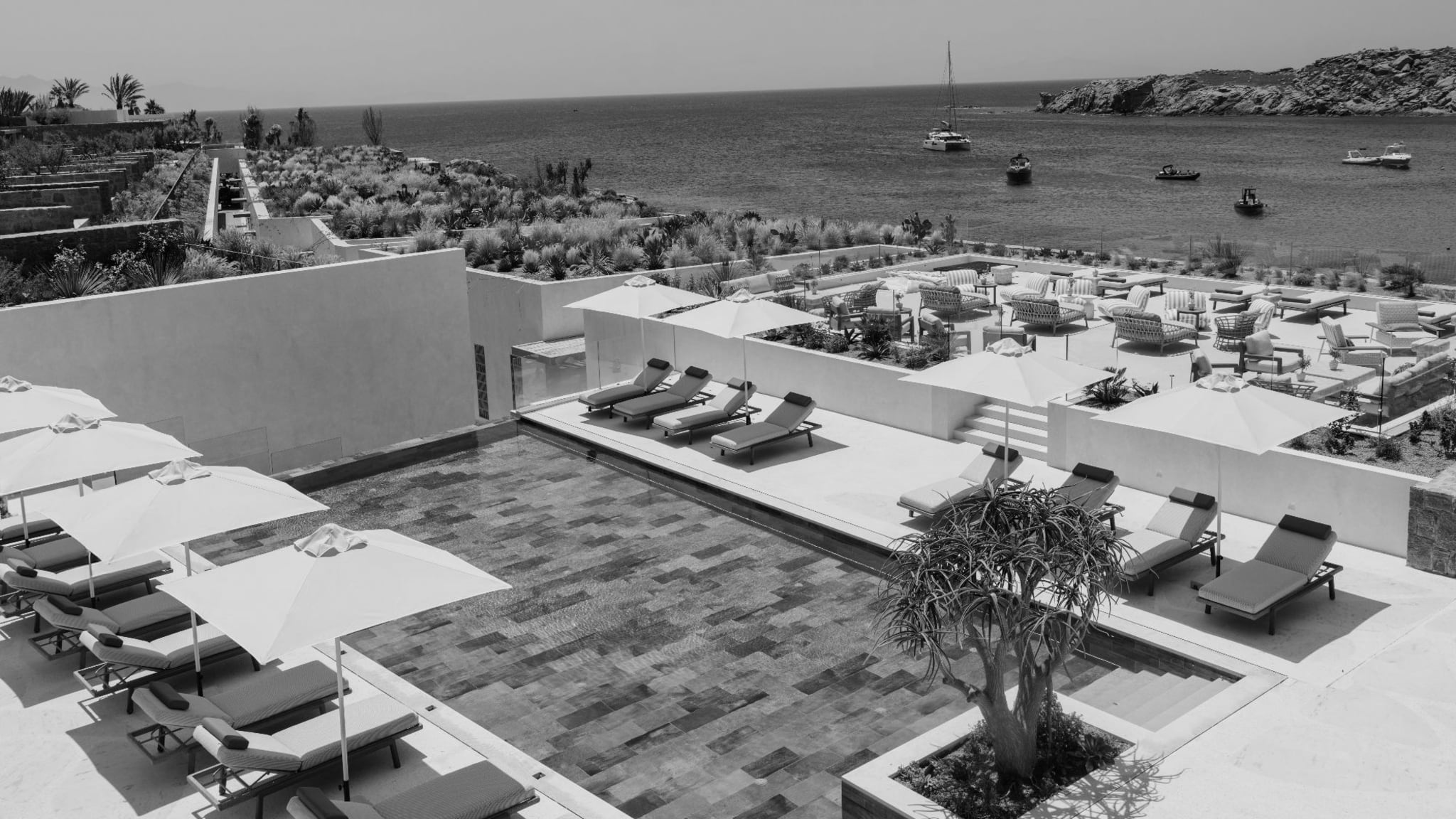
Designed by Divercity Architects, the property occupies a rocky southern edge of Mykonos between Paraga and Paradise Beach. Its 60 suites and three private villas are dispersed across the site in low, pale volumes whose terraces, pools and paths follow the slope towards the Aegean. From above, the composition reads less like a single monumental hotel than a small terrain of rooms, courtyards and planted roofs.
That distinction matters. In a destination where the horizon can become a form of theatre, the hotel uses enclosure as a means of relief. Stone walls do not simply decorate the suites; they make pauses between them, tempering wind and views while preserving the sensation of being close to the water. The architecture permits a guest to look outward, then step back from the gaze of the beach below.
This is not the vernacular reproduced as costume. The vocabulary is pared back: mineral surfaces, white volumes, deeply shaded edges and a palette that takes its cue from sun-bleached stone rather than polished glamour. Its success depends on restraint. The buildings sit low enough for the headland and sea to remain the visual subject.
The value of a threshold
Fouquet’s Mykonos is candid about offering both private seclusion and a more animated public rhythm. There are terraces facing the water, a beach and pool club, restaurants and a bar; there is also the Rock Spa, whose indoor pool and treatment spaces bring a markedly different atmosphere. Rock-textured surfaces, subdued light and water held in shadow create an interior counterpoint to the bright coast.
The contrast is useful rather than dramatic. A good resort does not make every hour feel identical. It provides a change in temperature, sound and scale: open sea at midday; a protected bar in the evening; a quieter, enclosed room when the body requires a reset. The bar’s curved timber ceiling and softly lit seating show how a shared space can feel composed without becoming ceremonial. Its design does not compete with the landscape outside; it gives the eye somewhere to rest.
Such thresholds are increasingly valuable in Mediterranean hospitality. Privacy is not merely the absence of other people, nor a larger villa behind a gate. It is the ability to move between degrees of visibility without friction: a private pool that still catches the sea air, a shaded terrace that does not sever the view, a room that feels protected while remaining part of its setting.
From spectacle to proportion
Mykonos is often described through extremes: brilliant light, late nights, beach clubs and an international summer crowd. The island’s appeal is real, but its visual economy can be exhausting when every viewpoint is designed for maximum announcement. Fouquet’s enters this environment with a more measured proposition. Its architecture acknowledges the lure of the panorama while using planting, masonry and a stepped plan to soften it.
The result is most convincing at the edges. Pools are held against terraces rather than projected as isolated gestures. Gardens and low planting interrupt expanses of paving. The coastal setting remains present, but the resort does not ask the guest to perform for it. That is a modest ambition, perhaps, yet it is precisely what gives the project relevance beyond its opening season.
There is also an intelligence in allowing different forms of sociability to coexist. The Aegean-facing pool club is deliberately public in mood; the villas, suites and spa give the property its quieter register. Neither cancels the other. Instead, the hotel treats retreat as a matter of choice and timing, not a permanent refusal of the outside world.
A Mediterranean idea of rest
The most persuasive luxury resorts have always understood that rest is spatial before it is procedural. It begins with a shaded passage, a well-proportioned chair, a view that does not demand attention, the coolness of stone beneath bare feet. At Fouquet’s Mykonos, these elements are used to make the island feel less like a stage set and more like a place to inhabit slowly.
This is particularly evident in the dialogue between the communal spaces and the coastline. The hotel does not turn away from Mykonos’s energy; it places a filter between that energy and the guest. Its private terraces, low walls and sheltered interiors offer intervals rather than escape routes. The distinction is subtle, but it separates a resort designed only for arrival from one that can sustain a longer stay.
For contemporary resort culture, that may be the more enduring proposition. The finest moments are not necessarily the most visible ones: an early swim before the beach changes tempo, a drink in a room softened by timber and lamplight, the return to a terrace where the horizon has become familiar rather than spectacular. This philosophy also informs ILHEMENT’s approach to sartorial resort loungewear: comfort considered not as retreat from the world, but as a more attentive way of moving through it.