Luura Paros Cliff and the Architecture of the Western Light
There is a particular challenge in making a new hotel on a Cycladic island. The architecture must offer release from the summer glare without making a spectacle of retreat; it must respect an inherited language of white volumes, thick walls and narrow passages without slipping into imitation. At Luura Paros Cliff, which welcomed its first guests on 1 August 2026, this balance is the essential proposition.
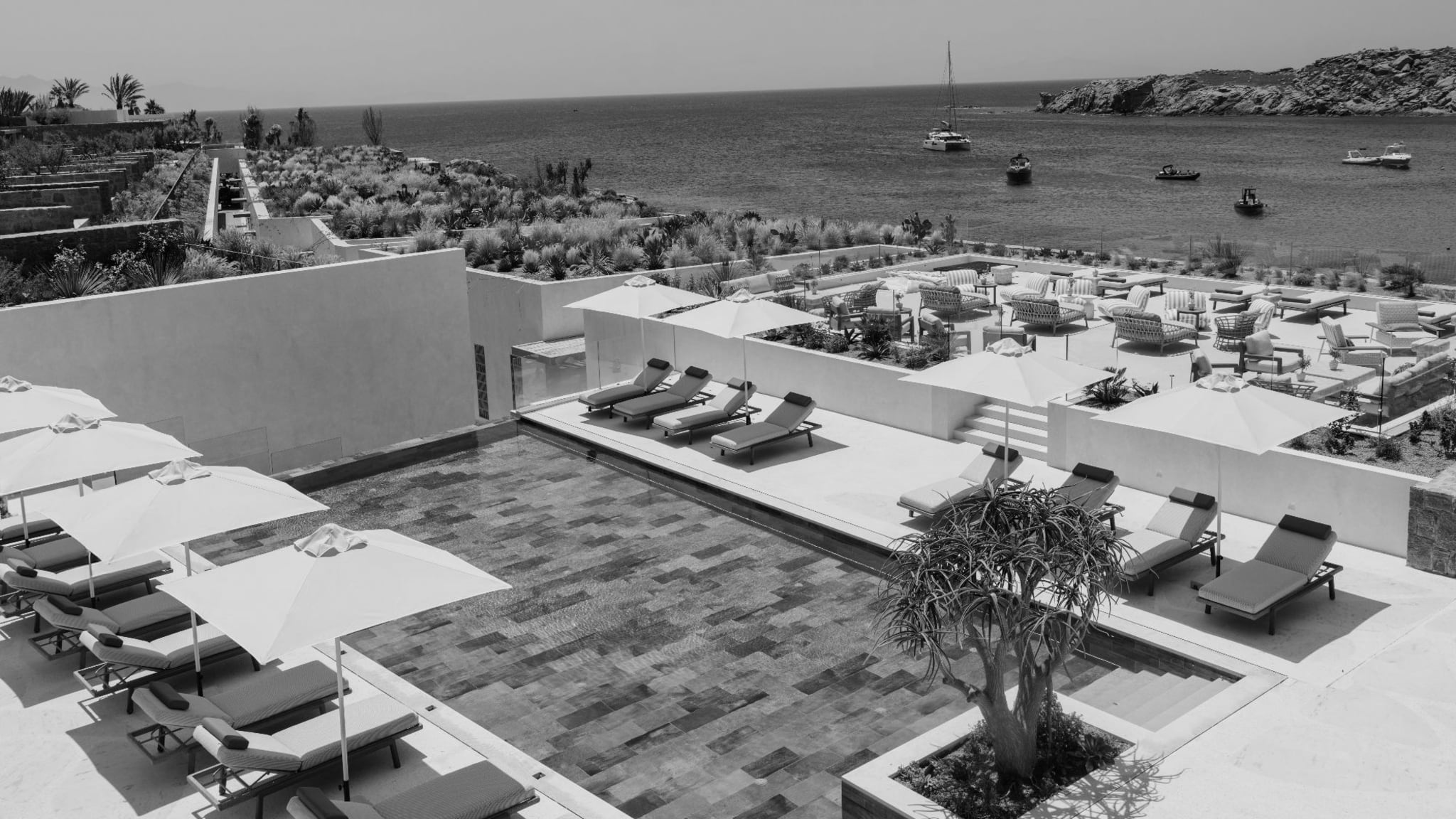
Set above the bay of Agia Eirini on Paros’s western coast, the 39-suite hotel looks across the Aegean towards Antiparos. Its appeal lies less in a single grand gesture than in the control of sequence: stone, shadow, a framed opening, a terrace, then the sea. The result is a retreat that treats the island’s strongest element, its uncompromising light, as material to be edited rather than merely admired.
A hotel composed as terrain
Luura Paros Cliff was designed by Athens-based Elastic Architects, with interiors by Lambs and Lions. The architectural language takes recognisable Cycladic components—plastered planes, masonry, pergolas and protected outdoor rooms—and gives them a more deliberate rhythm. Buildings sit low against the slope. Pale, roughly laid stone walls establish weight and texture; crisp rendered volumes provide contrast. Timber shade structures soften the threshold between interior and exterior.
This is not architecture that relies on theatrical arrival. Instead, it works through gradual disclosure. Changes in level, low walls and sheltered circulation lead the eye outward in intervals. The sea is continually present, but rarely presented all at once. That restraint matters on an island where the horizon can easily become a decorative shorthand. Here, the view is given cadence.
The arrangement also lends each part of the property a degree of independence. Every suite has outdoor space, while 19 have private pools. Yet the point is not to make privacy feel sealed or defensive. The terraces remain connected to the site through planting, stonework, open sky and the sounds that travel across the bay. In the best Mediterranean architecture, enclosure is never the opposite of openness; it is the means by which openness becomes bearable and pleasurable.
The discipline of shade
In the Cyclades, shade is not an accessory. It is a form of hospitality. Luura Paros Cliff understands this well. Pergolas filter the sun rather than block it entirely. Recessed doors and windows create dark, cooling intervals against light façades. Deep exterior thresholds allow a chair, a table or a morning coffee to sit between room and landscape without being exposed to either too much heat or too much attention.
That sequence gives the hotel an unhurried domestic quality. Its architecture does not insist on a programme of constant activity; it suggests that the day can be organised around smaller transitions. A swim before breakfast. A slow return to a shaded terrace. A lunch that does not require leaving the sea within sight. A change of light that becomes sufficient reason to move from one room to another.
This is where the project’s contemporary quality becomes most convincing. It does not attempt to make the Cyclades look newly invented. Rather, it recognises that traditional island architecture already contains sophisticated answers to climate, density and privacy. Thick walls delay heat. Small openings sharpen the value of a view. Courtyards and terraces make a life outdoors feel composed rather than exposed. Luura Paros Cliff revisits those principles with the comforts expected of a present-day hotel, but without losing their original intelligence.
Interiors that hold the horizon
The interiors continue the architectural argument in quieter tones. Earthy plaster, dark timber, woven surfaces and softly rounded forms keep the rooms grounded. Instead of competing with the Aegean, the palette makes space for it. Openings towards the water operate almost as pictures, while stone boundaries and shaded ceilings prevent the rooms from dissolving into generic beach-house brightness.
There is a useful tension between the hotel’s material density and its broad outlook. The masonry feels tactile and protective; the sea beyond it feels expansive and changeable. This is precisely what gives the property its sense of repose. The horizon is not consumed from a sunbed as an endlessly available backdrop. It is encountered through architecture: from a stair, beside a pool edge, through a window, beyond a dining table.
Luura also places art at the centre of its identity, drawing together works by local and international artists alongside pieces from the family collection. The ambition is not simply to furnish the rooms with cultural signals, but to make art part of the hotel’s conversation with Paros: an island whose long history of marble, making and myth remains palpable beneath its contemporary summer life.
A newer idea of island luxury
The hotel arrives at a moment when Paros is attracting attention as a less saturated alternative to the Cyclades’ more performative addresses. That shift brings its own risks. New hospitality can quickly turn an island’s clarity into a style, and style into repetition. Luura Paros Cliff avoids some of that by taking the site seriously. Its strongest quality is not novelty but calibration: the care with which it sets building against slope, pale surface against shadow, and private life against the open sea.
The destination offers the expected rituals—swimming, sailing, village walks, ceramics and local food—but the architecture provides a better framework for them. It gives guests a place to return to between encounters with the island, one that feels neither isolated from Paros nor absorbed by its summer spectacle.
For a resort hotel, that is a meaningful distinction. Luxury is often discussed in terms of access, space or service. Luura Paros Cliff suggests another measure: the capacity of a building to regulate attention. It lets the guest look outward when the view deserves it, and inward when shade, texture and stillness are enough. This philosophy also informs ILHEMENT’s approach to sartorial resort loungewear. In both cases, ease is not an absence of design, but its most disciplined expression.