Finca La Bobadilla and the Enduring Art of the Andalusian Village Hotel
There are hotels that offer a room, and there are hotels that propose a way of moving through the day. Finca La Bobadilla, reopened in 2026 after an extensive renewal, belongs firmly to the latter category. Set within 350 hectares of olive groves, Mediterranean woodland and low Andalusian hills between Málaga and Granada, it has long been conceived not as a single building but as a white village: a loose composition of courtyards, fountains, tiled roofs, passages and shaded thresholds.
Its return matters because it resists the current appetite for resorts that announce themselves at a distance. Here, arrival is deliberately gradual. The road carries guests through the estate before revealing the hotel’s whitewashed volumes, whose visual language draws on the settlements, farmhouses and palatial domestic architecture of southern Spain. The revised interiors and new wellness spaces have sharpened the comfort, yet the essential proposition remains intact: a retreat shaped by enclosure, water, weather and time.
A hotel made as a settlement
Finca La Bobadilla opened as a hotel in 1986, though its architecture was designed to carry the suggestion of a place accumulated over generations. It is an important distinction. The property does not imitate a monumental palace, nor does it rely on the isolation of a private villa. Instead, it uses the grammar of an Andalusian village: small squares that gather people briefly, lanes that allow them to disappear, and patios that turn climate into an architectural pleasure.
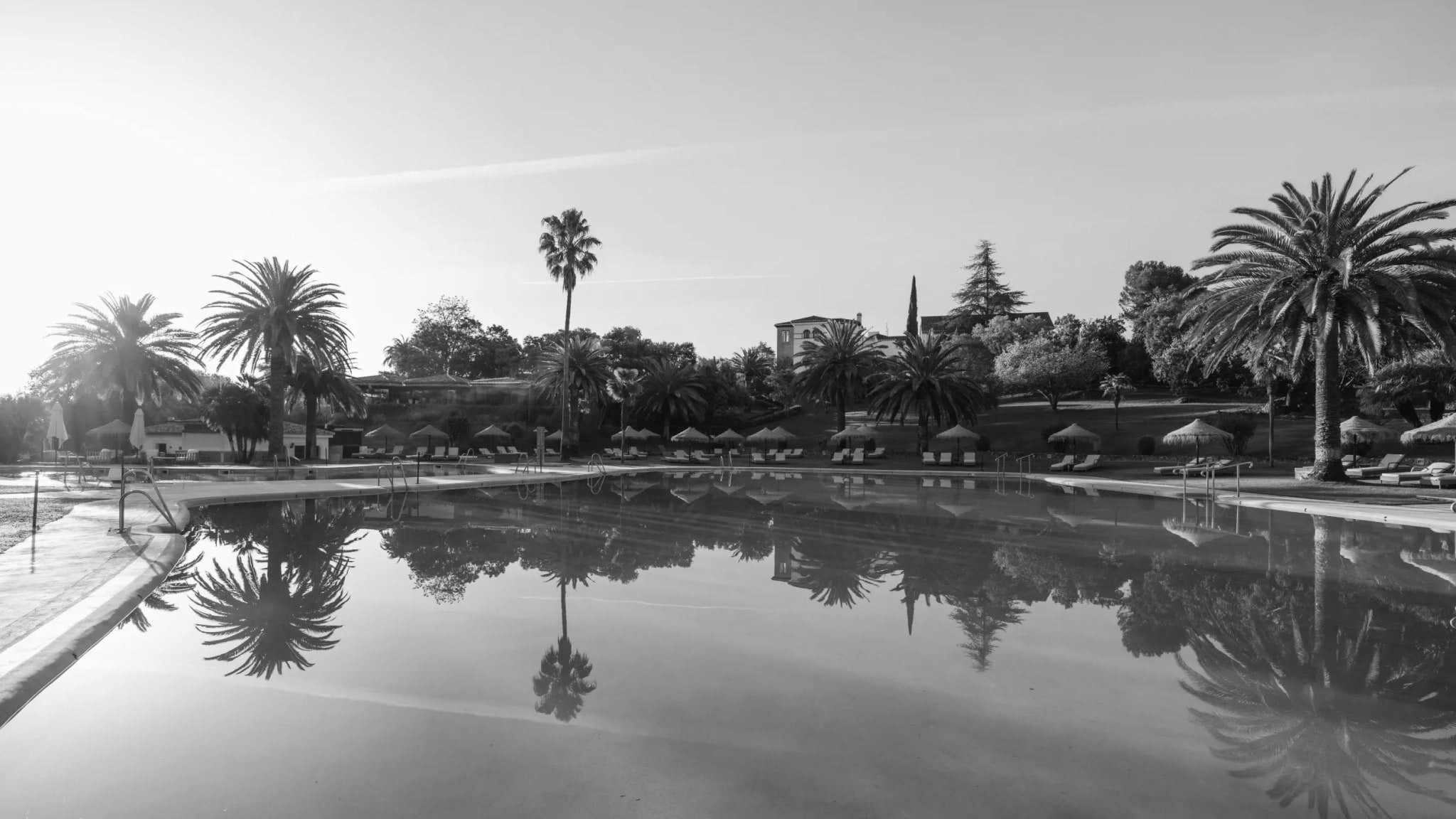
This is a particularly intelligent model for resort living. A guest may begin the morning in the calm of a suite, pass through a stone corridor to breakfast, stop beside a fountain, then return by another route as the heat rises. The hotel’s scale is softened by this sequence of smaller spaces. Privacy is not achieved through theatrical seclusion or excessive distance, but through choice: the choice of a quieter courtyard, a terrace above the cobbles, a place by the pool beneath a thatched parasol, or a walk beyond the buildings into the estate.
The renovation has retained the material vocabulary that makes the property convincing. Brick and terracotta floors, dark timber, ceramic tiles, wrought iron and pale plaster are not simply decorative references; they give rooms a sense of weight and temperature. The recently updated bathrooms bring contemporary ease without breaking the finca setting. This is the difficult part of a sympathetic renewal: not preserving every surface unchanged, but ensuring that new comforts do not interrupt the character that made the place worth returning to.
Water, shade and the discipline of pause
At Finca La Bobadilla, water is more than an amenity. Fountains provide a quiet acoustic thread through the courtyards, recalling the garden traditions of Granada and Córdoba, where moving water moderates the heat and alters one’s sense of pace. A pool, too, becomes less a spectacle than a place of suspension. The most satisfying hours are likely to occur in the unplanned intervals: after a swim, before lunch, when the light begins to slide across the garden and there is nowhere pressing to be.
This gives the hotel an emotional intelligence often absent from more programmed resort environments. Its pleasures are not dependent on constant instruction. Horse riding, cycling and walking across the estate are available, but so is the more subtle occupation of doing very little with concentration. A morning ride among olive groves can be followed by a long, cool return to the room; an afternoon treatment may end not with another appointment but with tea in the shade.
The new spa extends this logic. With saunas, a heated indoor pool and a hydrotherapy pool, it introduces a more formal sequence of restoration while remaining close to the estate’s slower rhythm. The point is not transformation by force, nor wellness as performance. It is the old and civilised idea that the body settles when it is given a measured alternation of heat, water, rest and quiet.
The value of a contained world
Contemporary luxury hospitality often speaks about connection to place, yet few properties make that connection spatially legible. At Finca La Bobadilla, the landscape is not merely the view from a restaurant terrace. It determines the journey in, the colour of the buildings, the changing scent of the air and the daily possibility of leaving the room without leaving the hotel’s world.
The estate’s horses are part of this sensibility. Riding here is not an imported lifestyle flourish but a fitting way to read the scale of the land: slowly, at ground level, with enough time to notice the olive trees, dry grasses and distant contours of the Sierra de Loja. Equally, the property’s deconsecrated chapel, home to a large private organ, offers a reminder that grand hotels need not confine culture to decorative objects. A dedicated room for music, ceremony or silence can alter the atmosphere of an entire stay.
Even dining benefits from the hotel’s village structure. Rather than concentrating every occasion in one all-purpose room, its restaurants and courtyards allow the day to have different registers: breakfast in clear morning light, a shaded lunch, an aperitif as the temperature falls, and dinner when the white walls begin to recede into evening. Such transitions are the substance of a proper resort rhythm.
Dressing for the unhurried day
The most persuasive places invite a corresponding change in dress, not as costume but as a practical response to their atmosphere. In an Andalusian finca, the ideal wardrobe understands the movement between cool interiors and bright courtyards, a terrace breakfast and an evening walk. Natural fibres, ease through the shoulder and a considered softness of construction feel appropriate because the setting asks for composure rather than display.
This philosophy also informs ILHEMENT’s approach to sartorial resort loungewear. The point is to be properly dressed for repose: garments with enough presence for a long lunch and enough comfort for the private hours that follow. Finca La Bobadilla’s renewed appeal lies in much the same balance. It is polished but not polished away; designed, but never detached from land, climate and the ordinary rituals that make a stay memorable.
Its lesson is timely. The finest resort hotels do not need to manufacture escape through novelty. They create conditions in which one can hear water, follow shade, take the longer path home and remember that rest is not the absence of activity, but a cultivated form of attention.