Aman Sveti Stefan and the Return of the Island Hotel
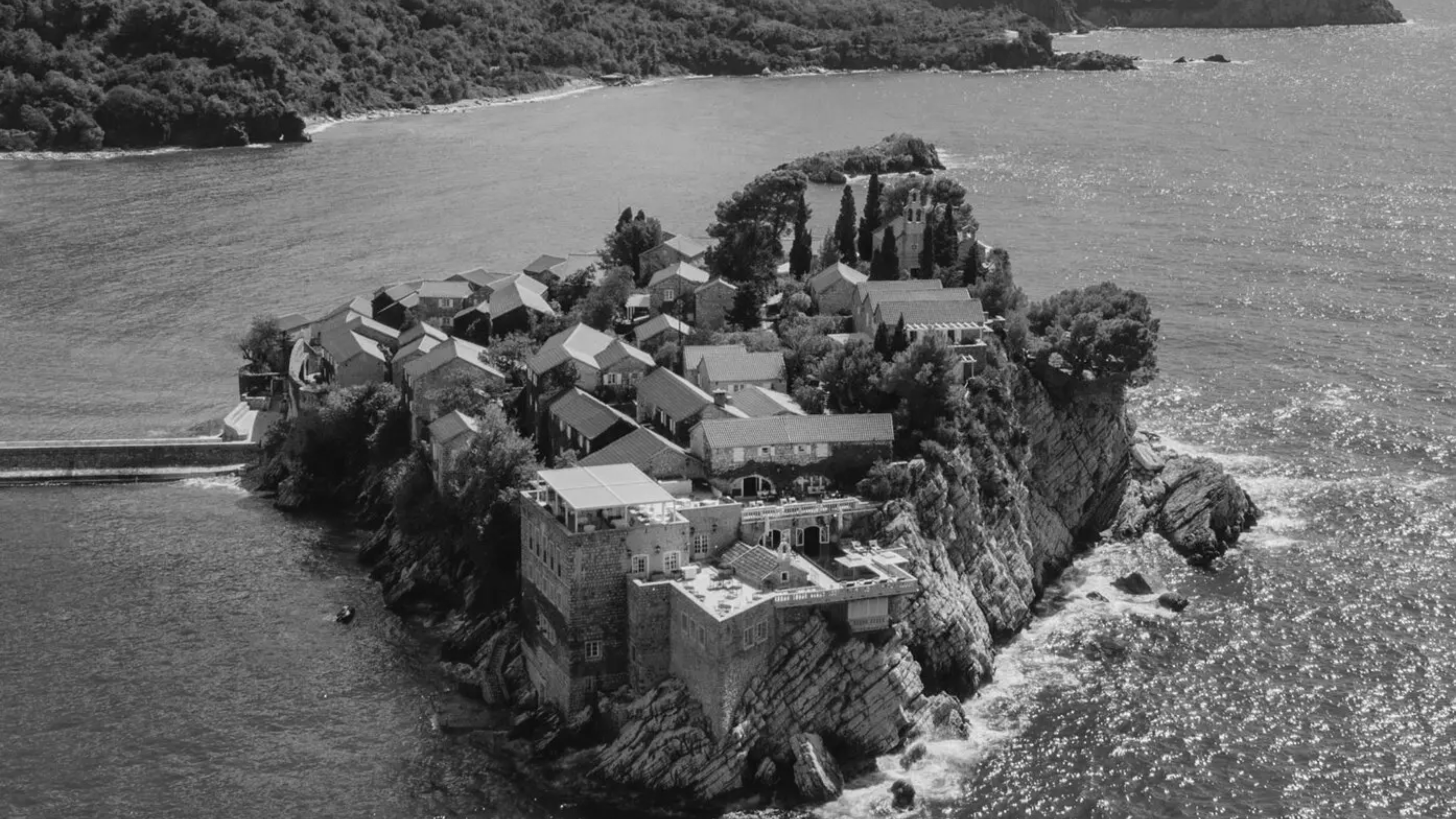
Some resorts command attention through scale; Sveti Stefan has always done so through silhouette. Its cluster of terracotta roofs, gathered tightly on a rocky islet and connected to Montenegro’s coast by a slender pale causeway, has the compressed force of an old maritime settlement seen from the water. On 1 July 2026, Aman Sveti Stefan welcomed guests again after five years of closure. The return is significant not because it introduces another Mediterranean address, but because it restores a rare kind of hotel: one whose architecture is inseparable from the place itself.
The reopening follows a settlement between the Montenegrin government and Adriatic Properties, the complex’s tenant and operator under the Aman name. The resolution brought an end to a lengthy period of uncertainty and allowed the island to resume its seasonal role, while Villa Miločer on the mainland returned as a year-round residence. For an Adriatic coast increasingly shaped by swift development, the reappearance of Sveti Stefan offers a more exacting proposition. It asks what hospitality can mean when it occupies a place with a prior life, a public memory and a form that should not be made generic.
An inhabited silhouette
Sveti Stefan’s particularity begins with its scale. This is not a resort arranged around a historical reference, but a former fortified village whose fifteenth-century stone cottages, lanes and small courtyards determine the experience of staying there. The island’s accommodation is distributed through those existing structures, so movement is naturally irregular: a turn in a cobbled passage, a shaded threshold, a terrace suddenly open to the Adriatic. Such conditions resist the smooth repetition that defines much contemporary luxury travel.
The effect is less theatrical than it may sound. The village form makes privacy architectural rather than merely operational. There is no need for conspicuous screening when stone walls, changes in level and narrow routes provide a natural rhythm of retreat. A guest may move from the open brightness of the causeway to the protective cool of a lane, then emerge again at a sea-facing terrace. The island’s appeal lies in this alternation between enclosure and horizon.
Across the bay, Villa Miločer provides a different register. The former royal residence is set within mature grounds of cedar, pine and olive, with suites looking either towards the water or into the wooded slopes behind it. Where the island is close-textured and elemental, the villa is more domestic in spirit: a place for long mornings, books left open in a sitting room and the unhurried return from a swim. Together, the two parts of the property make a convincing argument for contrast as a form of luxury.
The discipline of restoration
Heritage hospitality is often discussed as though preservation were a matter of surface: retain the stone, restore the shutters, add a few archival photographs. Sveti Stefan demonstrates the more difficult truth. The value of a historic setting resides in its proportions and patterns of use. A lane should remain a lane; a courtyard should not be forced into a lobby; the modest asymmetry of an old dwelling should not be flattened into a standard room plan.
That is why the island’s return carries more cultural weight than a conventional reopening. Its cottages cannot be enlarged into sameness without losing the very quality that makes them compelling. Their irregularity is not an inconvenience to be overcome but a reminder that genuine character comes from limits. The best rooms in old buildings are often those that ask the guest to slow down: to notice the depth of a window reveal, the grain of old timber, the change in temperature between sunlit stone and an interior wall.
The mainland spa extends this sensibility in a quieter, more contemporary way. Its sea-facing setting is centred on water, with hydrotherapy suites, an indoor pool and treatment rooms rather than an elaborate spectacle of wellness. This is appropriate to the site. The true restorative element is not novelty, but the changing Adriatic light: the silver morning surface, the dense blue of midday, the warmer colour that arrives once the heat loosens.
Privacy with a sense of place
Sveti Stefan also illustrates a useful distinction between exclusivity and isolation. The island offers seclusion, yet it is not detached from the coast around it. It remains one of Montenegro’s most recognisable landmarks, visible from the road above and from the beaches that curve around the bay. Its closure had made clear that a place of this kind is never only a hotel asset; it is embedded in local landscape and feeling.
The new chapter therefore has to be measured against more than the expectations of travellers. The settlement that enabled reopening also underlined the importance of a long-term relationship between the resort, its surrounding parkland and the public life of the coast. For guests, this need not diminish the experience. On the contrary, a stay becomes more resonant when privacy is understood not as the removal of all context, but as the privilege of inhabiting a place respectfully.
There is an old-fashioned intelligence in the rituals that follow from this setting. Breakfast is best taken before the day gathers momentum. A swim is not a programme but a pause between rooms. Evening belongs to the passage from shade to terrace, from the scent of warm stone and pine to the first movement of air off the water. These are small ceremonies, but they are the basis of a properly restorative stay.
The return of resort time
The Aman Sveti Stefan reopening arrives at a moment when Mediterranean hospitality is often preoccupied with immediate visibility: the panoramic pool, the crowded restaurant, the newness of the opening. Sveti Stefan proposes the opposite. Its strongest quality is its resistance to hurry. The island has endured because its architecture carries time within it, and because the most persuasive pleasures it offers are deliberately limited: sea, stone, shade, a room with a threshold, dinner at dusk.
This is also why it has relevance beyond Montenegro. The most enduring resorts do not need to invent a personality each season. They clarify the one already present in their site, then allow guests enough space to feel it. A linen shirt drying after a morning swim, sandals left outside a cottage door, a soft layer pulled on when the evening breeze rises: resort dressing is part of that same attentiveness to atmosphere rather than display.
For those drawn to places where rest has texture, ILHEMENT shares this belief that privacy, material and ease are best expressed with restraint. At Sveti Stefan, the lesson is written into the island itself. The future of cultivated resort life may not lie in building more, but in returning carefully to what already possesses permanence.