Borgo Santandrea and Amalfi’s Modernist Return
There is a particular kind of confidence required to make a new-old hotel on the Amalfi Coast. The landscape already supplies drama in excess: sheer limestone, tiled towns, boat wakes on brilliant water and terraces balanced above the Tyrrhenian Sea. The more interesting proposition is not to compete with it, but to make a place through which it can be properly seen.
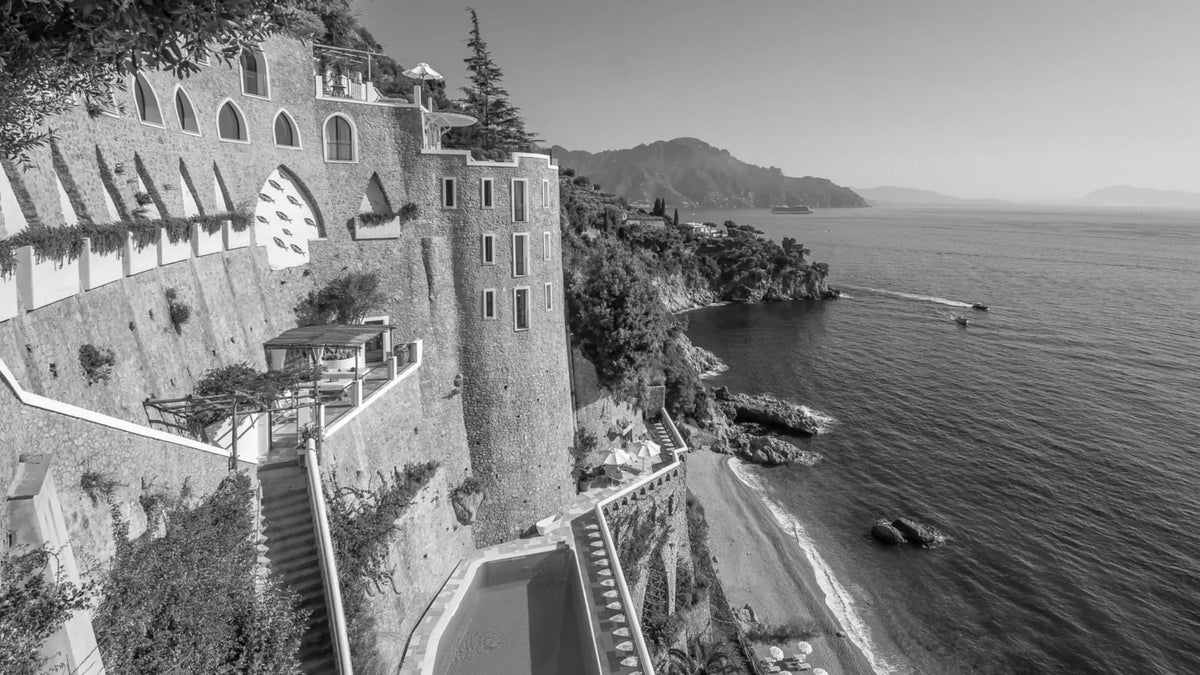
That is the achievement of Borgo Santandrea, the 1960s cliffside hotel at Conca dei Marini, a few minutes west of Amalfi. In September 2026, the property was promoted to Three MICHELIN Keys, placing it among the guide’s highest-ranked hotels. The recognition is useful not merely as a badge, but as confirmation of an unusually coherent project: a stay in which architecture, local workmanship, gardens, sea access and the daily pace of the coast have been made to speak the same language.
A modernist building with a local accent
Borgo Santandrea began as an existing hotel from the 1960s. Its four-year restoration, led by architect Rino Gambardella, did not attempt a sentimental reconstruction of a lost Amalfi. Instead, it treated the original structure as a capable framework: a sequence of terraces, arched openings and white volumes stepping down the cliff towards the water.
The result carries the clarity of Italian mid-century design without becoming a period set. White plaster, pale stone, brass and natural linen establish a deliberately calm base. Against it come the decisive blue-and-white surfaces: hand-made tiles, graphic floors, painted details and carefully selected furniture. The reference point is not abstract nostalgia, but the coastal modernism associated with Gio Ponti, whose work brought colour, geometry and a certain unforced optimism to post-war Italian interiors.
This is design that works through repetition rather than spectacle. Arches recur. Sea views are framed rather than simply exposed. A blue line at the edge of a floor or a tiled threshold has the effect of orienting the body as one moves through the building. The hotel’s strongest quality may be this choreography of descent: from suite to lobby, terrace and beach, the route remains legible, shaded and measured.
Craft as an organising principle
The hotel’s material world is grounded in Campania rather than applied as decoration after the fact. Local ceramicists, metalworkers, joiners and landscape specialists contributed to the restoration, while tilemakers created a family of patterns informed by the decorative vocabulary of Pompeii and Herculaneum. The point is not that every surface announces its provenance; it is that the building holds together because its details share an origin.
That approach is particularly clear in the rooms and suites. Their proportions are generous, yet the atmosphere is domestic rather than monumental. Curved ceilings soften the white volumes. Bespoke furniture sits alongside twentieth-century Italian pieces. In place of a maximalist Mediterranean scheme, there is a studied balance of crispness and ease: a deep-blue sofa, a pale chair, the calibrated shine of brass, then the horizon beyond an open terrace.
The hotel’s gardens extend the same thinking outdoors. Olive, lemon, pomegranate and myrtle lead the eye down the slope, breaking the journey from the upper terraces to the water into smaller, inhabitable pauses. On a coast where movement can so often feel like logistics, this matters. Borgo Santandrea turns access into part of the pleasure of staying.
The uncommon privilege of arriving by sea
The most persuasive architectural gesture lies at the bottom of the property. Nearly 90 metres below the road, a private pebble beach and small jetty give the hotel a relationship with the sea that is increasingly rare along this congested coast. Guests may take the lift, but the slower route through the gardens and stairways makes a better argument for the place: the shore appears gradually, with salt air replacing the scent of planting and the sound of traffic falling away.
At the beach, the atmosphere changes register. The old fishermen’s boathouse has been adapted for the beach club and its restaurant, retaining the practical scale and maritime character of the building. It is not an imitation of a village trattoria, nor an isolated club dropped onto the rocks. It remains tied to the working logic of the coast: boats, nets, shade, stone and the daily proximity of the water.
This is where Borgo Santandrea distinguishes itself from the more theatrical version of Amalfi. The property does not pretend that privacy means retreating from place. It offers privacy through sequence, distance and control of pace. A morning swim, a long lunch by the shore, an aperitivo above the coast and a return to the suite can all belong to one uninterrupted day.
A hotel made for the long afternoon
The 2026 MICHELIN recognition arrives at a moment when the most memorable hotels are being judged less by accumulation than by authorship. Borgo Santandrea has authorship in abundance. Its architecture is recognisable, its interiors are disciplined and its connection to regional craft is specific rather than rhetorical. Above all, it understands that coastal hospitality depends on the spaces between appointments: the shaded landing, the tiled passage, the quiet chair facing the sea.
That sensibility also gives the hotel a relevance beyond the Amalfi Coast. It makes a case for resort life as a cultivated rhythm rather than an endless programme. Clothes belong to that rhythm when they allow one to move with the same ease through private and shared spaces. Near the end of such a day, sartorial loungewear by ILHEMENT feels most compelling not as a costume for escape, but as a considered transition from suite to terrace and back into everyday life.
Borgo Santandrea’s modernist return is therefore not a revival in the superficial sense. It is a restoration of attention: to the cliff, the craft, the water below and the enduring intelligence of taking one’s time.