Ardbeg House and Islay’s Art of Productive Excess
On Islay, weather is not background scenery. It is an active material: blown across the ferry crossing, caught in the harbour light and carried indoors on wool coats and wet boots. Ardbeg House, in Port Ellen, understands this better than most new hotels. Its answer to the island is neither pared-back refuge nor a conventional whisky-themed inn, but a boldly composed house in which local lore, skilled making and sociability are given equal weight.
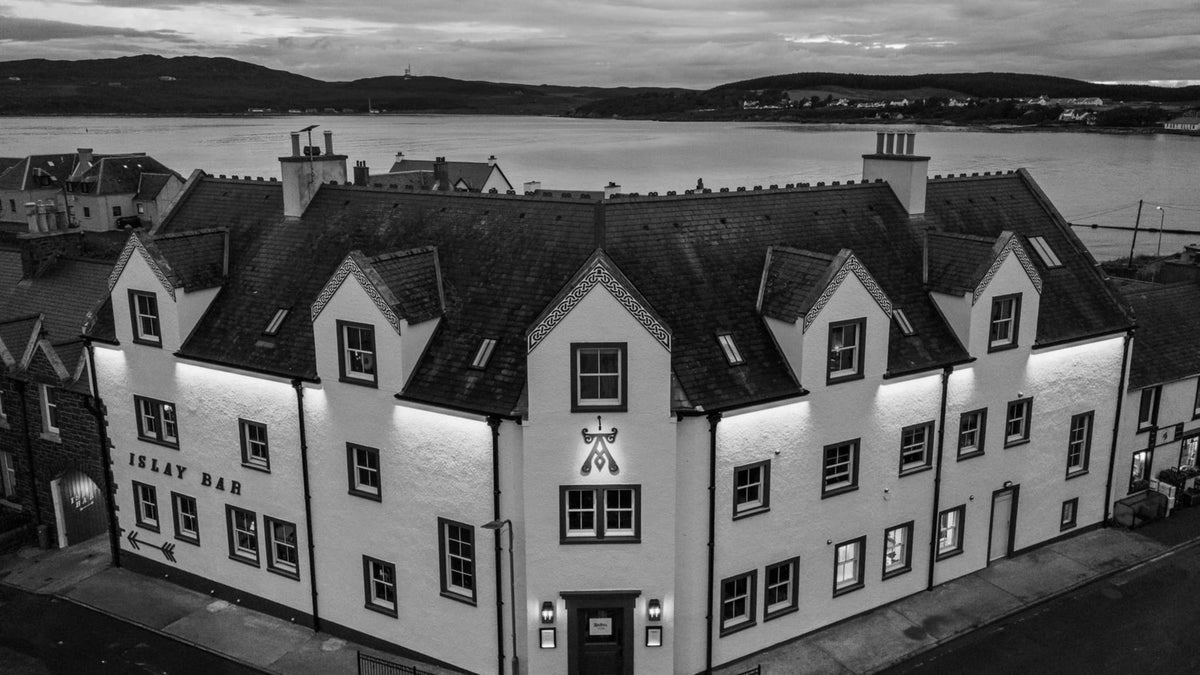
Opened in autumn 2025 in the former Islay Hotel, the 12-room property is connected to the nearby Ardbeg distillery but resists the easy logic of the branded outpost. This is a hotel with a particular atmosphere: one that makes room for peat, maritime weather, legends, collected objects and a bar that remains part of the town’s daily life.
A house with an island vocabulary
The building occupies a prominent corner of Port Ellen, facing the water and the small-scale rhythms of the village. Its white-painted exterior and green-framed windows remain reassuringly legible from the street. Inside, however, the experience changes register. Russell Sage Studio has treated the hotel as an interior narrative rather than a neutral envelope, drawing on the island’s geology, fishing culture, folklore and whisky-making history without reducing any of them to décor.
The result is deliberately dense. Reclaimed copper from retired stills appears within the fabric of the house; a chandelier made from a fishing boat gives one room a distinctly maritime silhouette. The bar is arranged beneath a suspended boat, while richly patterned surfaces, coloured glass, wood, metal and upholstered forms create spaces that reward a slower look. It is maximalism with a local grammar: not a collection of unrelated gestures, but an accumulation of references that belong to a wet, wind-shaped island at the edge of the Atlantic.
This matters because Islay has long had a visual culture of utility. Harbours, warehouses, whitewashed distillery buildings and crofting landscapes are not polished into abstraction. Ardbeg House borrows from that directness, then amplifies it through craft. The house is said to have involved more than 20 Scottish and Islay makers, and that collaborative approach is felt in the uneven, human quality of the rooms. Details do not appear to have been specified merely to fill a brief; they seem to have been chosen to keep a story in motion.
Twelve rooms, twelve propositions
There are only 12 bedrooms, each named rather than numbered and each shaped around an aspect of local myth, character or history. The approach could have slipped easily into theatricality. Instead, the rooms work because their visual abundance is balanced by clear hospitality. Beds, bathing spaces, reading corners and small places to sit retain their practical purpose even when surrounded by sea-monster motifs, deeply coloured textiles or unusually elaborate furniture.
The distinction is important. A memorable room does not need to behave like an installation. At Ardbeg House, the design asks guests to notice what is around them, but it also permits them to withdraw. The best hotel interiors hold these two impulses together: they make arrival feel vivid, then gradually become liveable.
That sense of participation runs through the small details. Guests are invited to find miniature bottles hidden in their rooms, an idea that turns the private space into a quiet game rather than a branded display. It is a modest ritual, but one suited to a house built around storytelling. The point is not simply to consume an atmosphere; it is to move through it attentively.
The bar as a public room
The Islay Bar is central to the project’s credibility. A bar has occupied the site since 1888, and its continuation as an open, locally minded room gives Ardbeg House a footing beyond overnight stays. There are more than 150 whiskies, but the deeper appeal lies in the room’s willingness to be social: a place for an early dram, a casual plate or a longer conversation after the weather has closed in.
Each evening at 18:15, the house marks Whisky Hour with a toast and a small-batch pour available only there. Such rituals can feel forced when they are detached from a place. Here, the timing is tied to the distillery’s commercial beginnings in 1815, connecting the hotel’s evening rhythm to a specific local history. It is theatrical, certainly, but it is also precise. The ceremony gives the day a hinge: guests return from a coastal walk, pause in the bar and enter the evening at the same tempo as the room around them.
The Signature Restaurant extends that thought through food. Its focus on island produce means the hotel’s narrative is not confined to wallcoverings and objects. Shellfish, fish, game and vegetables from the surrounding region place the dining room in a genuine supply network, while the setting remains dark, textured and intimate rather than rustic by default.
A new kind of Scottish hotel character
Ardbeg House is not interested in understatement, and that is its strength. The current fashion for softened, near-identical luxury interiors has made many country and coastal hotels difficult to distinguish once the names are removed. Here, the design takes the risk of being highly specific. A boat over the bar, reclaimed distillery copper and rooms built around local legend could have become gimmicks; instead, they are held together by careful spatial choreography and a conspicuous respect for the island’s working culture.
There is a useful lesson in that for contemporary hospitality. A hotel need not imitate domestic minimalism to feel restful. Rest can come from conviction: from entering spaces that know exactly what they are, from being offered a ritual with real provenance, and from seeing regional craft treated as a living language rather than a heritage display.
For ILHEMENT, that clarity has a parallel in oversized lounge trousers designed for movement between private rooms and shared spaces. At Ardbeg House, the transition from bedroom to bar is not a change of scene so much as a continuation of the same carefully built world: layered, hospitable and alert to the pleasure of staying a little longer.