Article: Le Sirenuse Mare and the Architecture of the Long Lunch
Le Sirenuse Mare and the Architecture of the Long Lunch
There is a particular problem with the modern beach club: too often, it mistakes proximity to the water for a complete idea. A line of loungers, a loud bar and a polished menu may create a scene, but rarely a place. Le Sirenuse Mare, the new Nerano outpost from Positano’s Sersale family, proposes something more disciplined. It treats the shoreline not as a stage, but as the beginning of a carefully paced architectural sequence.
Opened in 2026 to mark the seventy-fifth year of Le Sirenuse, the project sits on garden terraces above the Bay of Nerano, reached by road or directly by boat. It is independent from the hotel in Positano, yet clearly shaped by the same family instinct: hospitality as a world of cultivated details, rather than a collection of amenities. The result is not a miniature version of the famous palazzo above Positano. It is a different proposition, calibrated for salt air, a long table and the interval between swimming and lunch.
A coastline edited through terraces
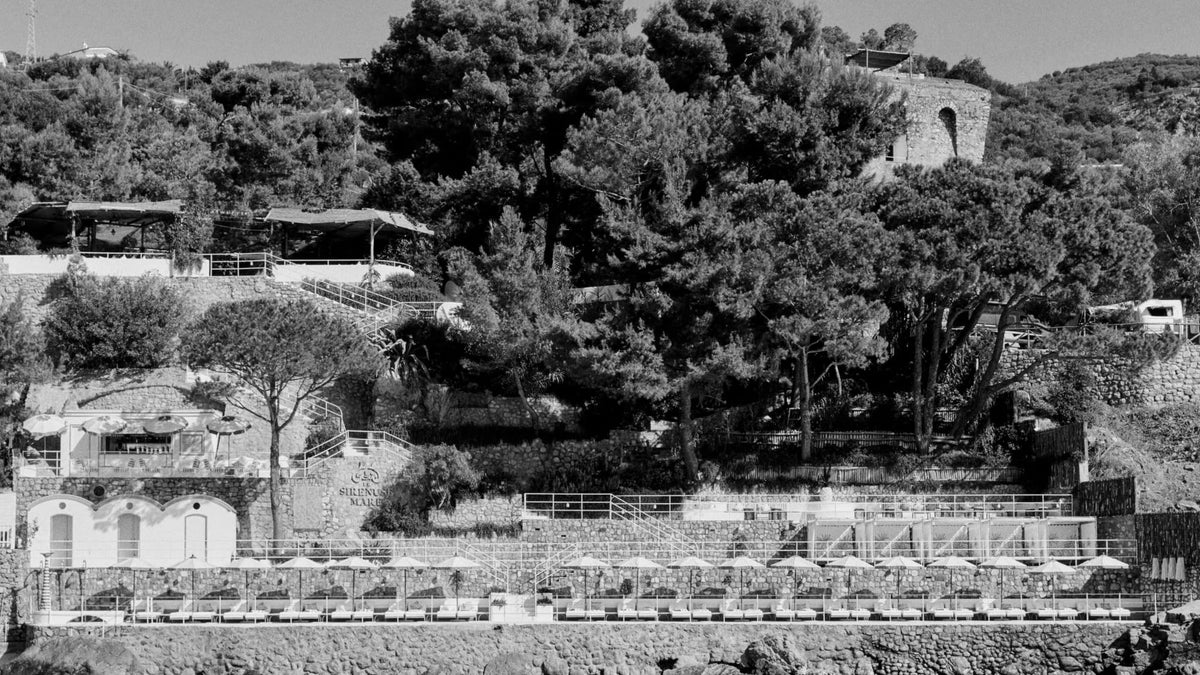
The Le Sirenuse Mare beach club has been arranged across roughly 2,500 square metres of rising coastal ground. Rather than flattening the site into one expansive deck, the architecture follows its existing levels. The lower edge meets the water and pebble shore; above it, stone retaining walls, planted banks, shade structures and dining spaces ascend in measured stages. Arrival is consequently not instant. A guest sees the place gradually, from sea level through the layers of its gardened terrain.
This is a material decision as much as a spatial one. The Milan-based studio Architetti Artigiani Anonimi led the architecture and design, with landscape work by Paolo Pejrone and lighting by Hervé Descottes’ L’Observatoire International. Their approach privileges the coastal vocabulary already present in Campania: handmade terracotta, ceramic tiles, chestnut pergolas and cannucciata, the undulating woven reed screens traditionally used for shade. None of these elements is unusual in isolation. Their force lies in their accumulation, each one lending texture without competing for attention.
That restraint matters on an Amalfi coast increasingly crowded with polished replicas of Mediterranean ease. Le Sirenuse Mare does not attempt to disappear into the hillside, nor does it reach for a generic language of contemporary resort minimalism. It uses colour, pattern and ornament, but gives them a structure. Stone remains the anchor; the sea is visible from multiple levels; shade is treated as architecture rather than decoration.
Craft as a social instrument
The strongest hotels understand that materials direct behaviour. A tiled floor changes the tempo of a room. A pergola establishes a threshold between heat and shelter. A hand-finished plate asks a diner to notice the table before the food arrives. At Nerano, these small interventions create a setting for sociability that is deliberately unhurried.
The 180-cover restaurant is set beneath chestnut pergolas, with ceramics developed for the project by Emporio Sirenuse creative director Viola Parrocchetti and made in Vietri sul Mare. The choice is more than a regional flourish. Vietri’s ceramic tradition carries the irregularity, mineral colour and visible hand of the coast; its use prevents the dining room from becoming a smooth international terrace that could be transported anywhere. Lunch is given a proper architectural frame: neither a quick service beside the pool nor an over-formal destination restaurant, but an occasion that may absorb an afternoon.
There are three bars, a gelato counter and a small Emporio Sirenuse shop, yet the project’s rhythm remains legible. The spaces are distributed rather than concentrated, encouraging movement between water, garden, table and terrace. This is hospitality as choreography, but without theatrical pressure. One can arrive for a swim, drift up for something cold, settle into lunch, then remain in the shade as the light changes on the bay.
An art programme without a gallery voice
Le Sirenuse has long made art part of its identity, notably through its ongoing programme of artist commissions in Positano. At Mare, art is placed less as an interruption than as another inhabitant of the terraces. Works by Alba Clemente, Giuseppe Ducrot and Lucio Liguori appear among planted routes and social spaces, while a monumental painted-bronze pineapple by Rose Wylie gives the bar bearing her name a suitably offbeat landmark.
The most persuasive gesture is the central fountain by Ducrot, made in fired and glazed refractory clay. It occupies the upper lounge rather than a sealed white room, allowing sculpture to enter the ordinary business of a day out: towels, conversation, gelato, the repeated movement of staff and guests. This is a useful corrective to the idea that cultural programming must announce itself loudly. Here, art supplies character and memory, but the beach club retains the easy, inhabited quality of a place intended for use.
The distinction is important because Le Sirenuse Mare is not merely a branding extension. It is the outcome of a lengthy local project, conceived over five years and placed in a fishing settlement whose pace differs sharply from Positano’s centre. Nerano has its own culinary and coastal identity, and the beach club acknowledges that condition through its stepped form, its handmade surfaces and its refusal to make the sea view do all the work.
What a resort day can hold
Great resort architecture is not necessarily about seclusion. It is about giving privacy, conviviality and landscape their own moments without forcing a choice between them. Le Sirenuse Mare does this through distance and gradation: a private jetty below, planted terraces above, open tables under timber shade, and enough spatial variety to make staying in one place feel like a sequence rather than a pause.
That is also why the project feels connected to contemporary ideas of dressing for resort life. The day does not stop at the water’s edge; it passes from lounger to lunch, from shaded terrace to evening boat, without requiring a costume change at every turn. Near the end of such a day, ILHEMENT’s oversized lounge trousers suggest a similarly composed approach: clothing with enough ease for the private hours, but enough structure to move naturally through the shared ones.
Le Sirenuse Mare’s achievement is not that it offers another route to the Amalfi coast’s famous glamour. It is that it slows that glamour down. In the rhythm of terraced stone, hand-made shade, ceramic surfaces and a lunch that is allowed to take its time, it offers a more convincing form of coastal luxury: one built not on spectacle, but on the patient pleasure of remaining.