Brenners Park-Hotel & Spa and Baden-Baden’s Art of Repair
There are restorations that announce themselves with spectacle, and restorations that understand the greater achievement is continuity. Brenners Park-Hotel & Spa belongs firmly to the latter category. Set beside Baden-Baden’s Lichtentaler Allee, with the River Oos running quietly beyond its park, the hotel has returned from a far-reaching renewal with its particular grammar intact: balconies, trees, marble, shaded terraces and the civilised assurance of a house that has watched the spa town change around it.
For a property founded in 1872, the question was never whether to modernise. It was how to do so without turning a grand hotel into an expensive imitation of contemporaneity. The answer is measured rather than nostalgic. Brenners has updated its systems, rooms and wellbeing spaces while retaining the slightly formal, deeply domestic atmosphere that makes a great European hotel feel less like a product than a lived-in institution.
A house with a memory
Baden-Baden has long understood that restoration is not simply a medical matter. Its thermal culture evolved around the idea of taking time seriously: walking, bathing, dining, reading, dressing for dinner and returning to the same places until they become part of one’s own private geography. Brenners is inseparable from that rhythm. Its position beside the Lichtentaler Allee gives the hotel an unusual relationship with the town: close to museums, baths and casino salons, yet buffered by mature greenery and the soft sound of water.
The recent renovation, guided by Countess Bergit Douglas of MM Design, did not treat the building as a blank canvas. Its purpose was to preserve a recognisable Beaux-Arts character while making the experience more intuitive for contemporary guests. Restored antiques, patterned wallcoverings, timber, marble and carefully selected fabrics remain part of the visual language. The result is layered but not theatrical. A room may carry colour, pattern and a sense of inheritance, yet it still leaves space for daylight, the view towards the park and the unhurried habits of a long morning.
This restraint matters. Too many heritage renovations confuse contrast with relevance, inserting stark minimalism where a house requires calibration. At Brenners, the ambition has been more exacting: to restore a sense of ease. Even the practical decisions support that idea. Behind the scenes, the hotel’s infrastructure has been substantially renewed; in the public rooms, however, tactile brass switches and familiar proportions keep the encounter human in scale.
The intelligence of keeping things
The most persuasive detail of the restoration may be its refusal to erase accumulated character. In the fireplace room, existing furniture was retained in its established arrangement rather than displaced for a new visual statement. That decision says much about the hotel’s approach. Grand hotels need renewal, but they also need places in which repetition is reassuring. The chair one remembers, the corner chosen for tea, the route from lift to room: these small continuities are not decorative extras. They are part of the hospitality.
Elsewhere, refreshed tones, new lighting and contemporary artworks introduce a lighter register without making the interiors anonymous. The effect is especially convincing in shared spaces, where the hotel’s scale is balanced by the feeling of a well-run private residence. Arrival is not designed as a dramatic interruption. It is a gradual adjustment from street to park, from public pace to a more deliberate tempo.
That sequence is also why Brenners feels culturally specific rather than merely luxurious. Baden-Baden’s tradition is not one of escape from the world but of returning to it restored, better dressed and more attentive. The hotel’s rituals extend beyond treatment rooms: breakfast overlooking the avenue, an aperitif on the terrace, a walk through the park, the discreet choreography of service. Such moments offer a contemporary use for old-world formality. They create room for solitude without making seclusion feel isolating.
Wellbeing without the blank slate
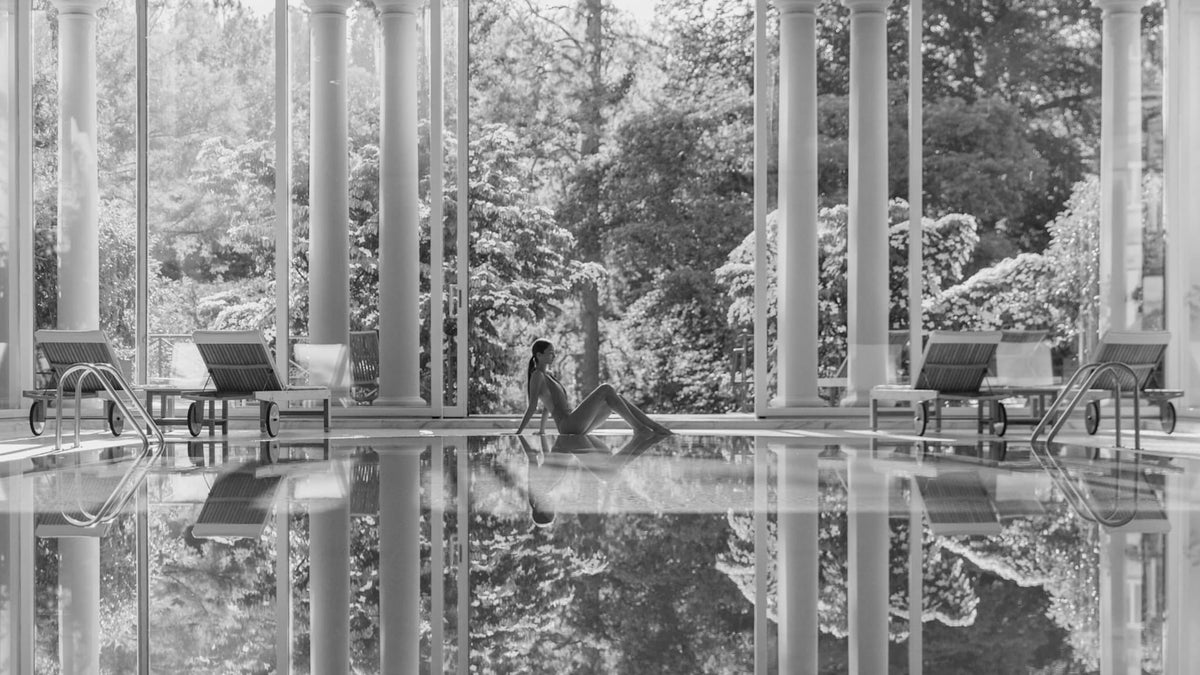
Villa Stéphanie, the hotel’s dedicated spa and wellbeing house, gives this philosophy its clearest physical form. Its pool, framed by classical columns and garden views, avoids the sealed-off atmosphere of many modern wellness spaces. Water, light and foliage remain in conversation. The point is not to manufacture an abstract sanctuary but to make Baden-Baden’s historic culture of bathing feel present-tense.
The wider offer includes sauna and wet areas, medical care and nature-led activity in the surrounding Black Forest. Yet the setting is most compelling when it asks least of the guest. The hotel’s park permits a gentler kind of intermission: a swim followed by a chair in the sun; a slow walk along the Oos; an afternoon that remains open enough for a book, a nap or no particular plan at all.
That is where Brenners distinguishes itself from the contemporary obsession with optimisation. It understands that repair can be architectural, technical and emotional without being over-explained. The hotel does not need to abandon ceremony to feel current. Instead, it makes ceremony useful again: a way of giving shape to time.
From room to park
For ILHEMENT, the relevance lies in that same consideration of transition. The hotel’s renewed interiors invite clothes that do not belong to only one setting: pieces with generous proportions that can move from suite to breakfast room, across a terrace and back into ordinary life without changing their character. A softly structured sartorial loungewear wardrobe makes sense here not as costume, but as an extension of Baden-Baden’s old intelligence about being at ease in shared spaces.
Brenners Park-Hotel & Spa does not present heritage as a sealed historical scene. Its achievement is more difficult and more durable. It keeps the texture of a grand hotel visible, then lets the forest, the water and the rhythms of the day make it newly useful.