

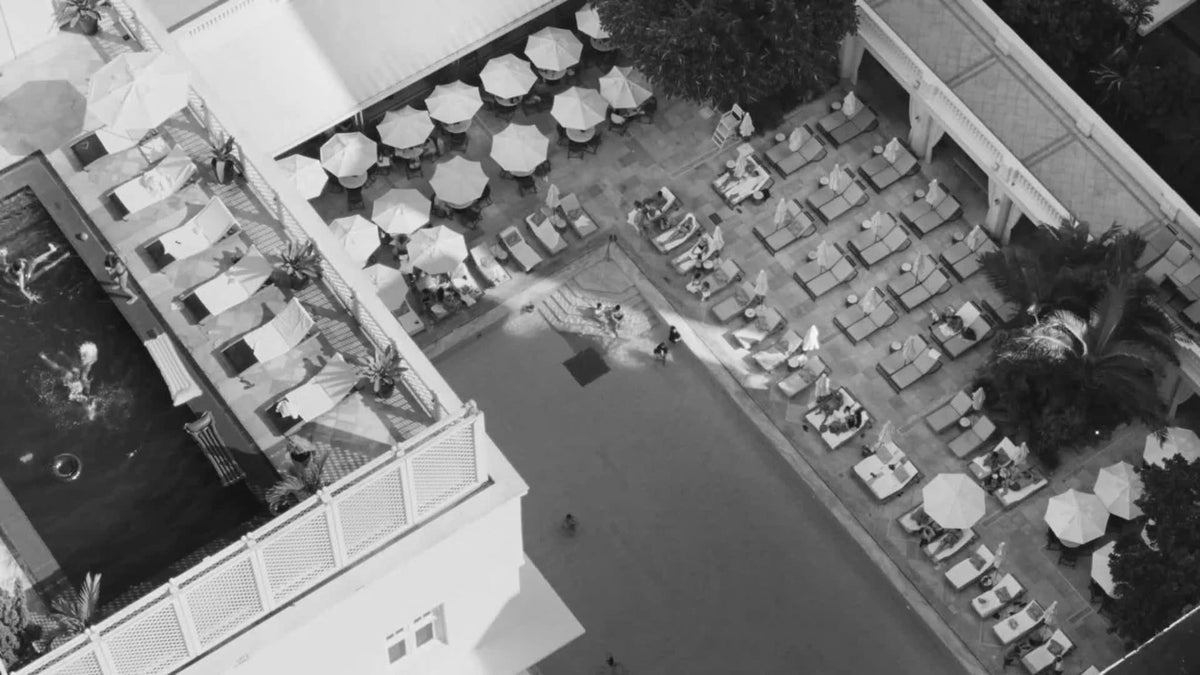
Copacabana Palace and Rio’s New Pool Wing
Some hotels are inseparable from the cities around them. Copacabana Palace does not simply face Rio de Janeiro’s most celebrated beach; for more than a century, it has helped choreograph the social life around it. Its pale façade on Avenida Atlântica has provided a threshold between the promenade and the city’s interior world of ballroom evenings, theatre, poolside afternoons and long, unhurried departures.
This autumn, that world enters a carefully considered new phase. The hotel’s 1948 Pool Wing remains under renovation until November 2026, while the main pool is scheduled to reopen on 9 October. The distinction matters. This is not a wholesale reinvention of the hotel, nor a new property posing as heritage. It is a return to an existing architectural proposition: a modernist annex built for guests who intended to stay in Rio for longer than a weekend.
A palace with a modernist counterpart
When Copacabana Palace opened in 1923, it was conceived as a grand address for a changing Rio. Its French architect, Joseph Gire, gave the building an eclectic, ceremonious frontage whose scale and symmetry still register against the sweep of the beach. The hotel arrived at a moment when the city was looking outwards, and its public rooms soon became part of Rio’s civic imagination.
The Pool Wing, built in 1948, introduced a different register. Designed by Wladimir Alves de Souza, it brought tropical modernism and a more relaxed relationship to outdoor life into the compound. Rather than mimicking the main building, it answered it: geometry in place of grand façade, pool terrace in place of ceremonial arrival, and a more residential idea of the hotel stay.
That duality is central to the property’s continuing appeal. The main building has always carried the weight of occasion, while the Pool Wing has offered a looser rhythm around the water. The renovation, led by Brazilian architect Ivan Rezende, returns to that logic rather than flattening it into a single house style.
Brazilian material culture, not decorative shorthand
The forthcoming wing will contain 68 suites within a hotel total of 208 rooms and suites. Most are planned with private balconies, sitting rooms and the capacity to connect for longer stays by families or groups. Yet the more interesting proposition lies in how the interiors are being assembled.
Rezende’s scheme brings together contemporary furniture of his own design with pieces by Sergio Rodrigues, a defining figure in Brazilian modernism. Native woods, stones quarried across Brazil and reclaimed timber from the Amazon riverbed are intended to provide the material base. This is complemented by bespoke work from Ciro Fernandes, whose woodcuts draw on Brazilian flora and fauna, and Maqueson Pereira da Silva, whose marquetry uses naturally coloured reclaimed Amazonian timber.
Such detail can easily become a catalogue of names. Here, however, the ambition appears more structural: to move the Pool Wing away from a generic international idea of resort polish and towards a room-by-room conversation with Brazilian making. Rugs informed by satellite views of Acre and the Juruá River extend that thought underfoot, translating landscape into a quieter domestic scale.
The result, if realised with the restraint suggested by the early material descriptions, should make the wing feel less like an annex and more like a concentrated portrait of the country. Its specificity is particularly welcome in a hotel whose public image has often been defined by spectacle.
The pool as a social room
At Copacabana Palace, the pool has never been merely an amenity. It is a shared room without walls: a place where beach life, local sociability and hotel ritual overlap. The redesign will give its base a new pattern inspired by the movement of the sea beyond the promenade, while a new Bar do Copa is intended to establish a more deliberate evening rhythm beside the water.
The renovation also introduces a contemporary Italian restaurant, still to be formally unveiled, and a boutique dedicated to Brazilian craftsmanship. These additions are not incidental. They recognise that the most successful grand hotels are not sealed environments. They make space for the city’s makers, conversation and daily cadence, allowing guests to feel they are staying in a place rather than merely observing it.
Five floors of the renewed wing will be dedicated to wellbeing, with a spa, fitness facilities, Pilates and movement spaces, ice baths, infrared sauna, steam rooms and a beauty salon. It is an unusually extensive programme, but its strongest idea is not intensity. It is range: a hotel historically associated with Rio after dark making equal room for the morning after.
The long stay, restored
The Pool Wing was originally made for seasonal residence, when travellers might arrive with enough time to establish a routine. That notion feels newly relevant. Contemporary hospitality often treats privacy as a matter of seclusion; Copacabana Palace proposes something more nuanced. Privacy here can mean having a suite large enough to retreat to, before returning to a terrace, the pool, the theatre or the city beyond the gates on one’s own terms.
It also explains why the wing’s return should be read as more than a renovation news item. The project restores an architecture of duration. It makes room for the small transitions that give a stay its character: breakfast becoming a slow poolside afternoon; a pause upstairs becoming a drink by the water; the suite becoming the starting point rather than the destination.
There is a useful sartorial parallel in this kind of living. The best resort wardrobe is not costume for the beach or formality for dinner, but clothing with sufficient proportion and composure to move between private and shared spaces. Near the end of a long day at the Copa, Swiss-designed sartorial loungewear with generous shapes and considered pleating feels aligned with that same idea of transition: made for the suite, but not confined to it.
When the Pool Wing reopens in November, its success will rest on whether it retains this balance. Copacabana Palace does not need to be made new. It needs its different architectural tempos to remain legible: Gire’s grand public façade, Alves de Souza’s modernist counterpoint, and Rezende’s contemporary layer of Brazilian craft. Rio has always rewarded hotels that understand life is lived at more than one speed. This one is preparing to do so again.


